Showing posts with label Very Small Things. Show all posts

Saturday, March 14, 2009

Back to my emails...

Just taking a break in my preparations for Finals Week, as I can't afford to neglect my email any longer. As usual, there's some pretty cool things as far as news@nature goes. So here I shall display the ones I have found most interesting, in the order in which I have viewed them.

Obama overturns stem-cell ban

President's executive order will allow US human embryonic stem-cell research to thrive at last.

Scientists and research advocates worldwide are celebrating the removal of rules limiting research on human embryonic stem cells in the United States, which they say have restricted the field's progress for seven and a half years.

The National Institutes of Health (NIH) in Bethesda, Maryland, is now working out policies that will allow researchers to apply for grant money from the agency to study some of the hundreds of cell lines created since 9 August 2001, when President George W.


One of the many reasons I like this Obama guy. I wonder how many thousands of unwanted embryos have been destroyed in vain when they would have otherwise been donated to researchers?
` I hope that U.S. scientists can catch up to other countries that have been studying embryonic stem cells all this time....

What else we got?

Evidence for ancient horse ranch uncovered

Traces of earliest known milking of horses in Kazakhstan.

Humans rode and milked horses as early as 3500 BC, say an international group of researchers. The findings come from ancient settlements in Kazakhstan, where horse jawbones showed signs of bridling and ceramic cooking vessels contained traces of horse milk.


Though humans have evidently had a long history with horses, dogs have been domesticated some 13,000 years B.C. or longer, as betrayed by their remains having been put in human burial sites.

Oh no, looks like some rainforests might actually compound carbon emissions!

Climate change crisis for rainforests

Drought could turn carbon sinks into sources.

The tropical forests of South America, Africa and Asia take up and release huge amounts of carbon each year. On the whole, they are a significant 'sink' for atmospheric carbon dioxide, but their future role in sequestering the greenhouse gas is uncertain.


Apparently, when vegetation dies, it releases carbon. Droughts can cause enough of the forest plants to die off, emitting more carbon than the rest of the forest can absorb! Oh bother....

And now, scientists may have to rethink what makes atoms do what they do....

Atomic nucleus takes two shapes

The squashed heart of a sulphur isotope fluctuates between different states.

Contrary to some expectations in the world of nuclear physics, researchers have found that a radioactive nucleus of sulphur oscillates between two different shapes, sometimes appearing like a sphere and other times like an American football. The result, reported this month by researchers in France, is causing nuclear physicists to rethink prevailing theories about what makes some nuclei stable and others prone to splitting apart.


I would assume that understanding this distinction may allow greater control over how one can manipulate atoms. You know, like for a new kind of nuclear power or some kind of other technology which may or may not feature 'splosions.

And here we have yet another use for genetic decoding...

Genetic test predicts eye colour

Forensic tool could help catch criminals.

Cheryl Jones

Police might soon be able to tell the eye colour of criminals from DNA recovered from crime scenes, thanks to a new genetic study.

A team of scientists led by Manfred Kayser, of Erasmus University Medical Centre in Rotterdam, has developed a method that predicts eye colour with unprecedented accuracy.


And here's another thing where our genetic past has come back to haunt us. Genes do that a lot, contrary to what you might think, though usually it seems the gene simply becomes inactive for a while before a new mutation activates it again.
` This, however, is different....

The resurrection of a disease-linked gene

An unusual tale of a gene lost, then found, during human evolution.

A glimpse into the evolutionary history of a gene linked to Crohn's disease has revealed a bizarre example of just how dynamic genomes can be.

The gene, called Immunity-related GTPase M (IRGM), seems to have been destroyed in the ancestor of Old and New World monkeys millions of years ago, only to be brought back to life again in the common ancestor of humans and great apes when a retrovirus lurking in the genome inserted itself into the gene.

Interesting. So, from what I know, a retrovirus is a carrier of genetic information, which replicates itself by inserting its RNA into a host cell and reverse-transcripts it into DNA, and it winds up becoming part of the cell's DNA.
` If it's a germ cell, it gets passed on into the next generation. I wish I remembered exactly how it works, though I don't have time for any more research.
` Apparently, this disease mutation somehow got into a retrovirus which carried it all over the place until it wound up settling down in the ancestors of humans and our closest ape relatives.

Bear in mind that my memory would be partly refreshed if I were able to access the rest of the article.
` *Sigh*. It's sad how much one can forget over... a decade. Anyway.... here's something I can understand better.

Microbicide protects monkeys from HIV-like virus

Gel may fight virus by suppressing counterproductive immune responses.

A microbicide made from glycerol monolaurate — an ingredient in some foods and cosmetics — can protect female monkeys from contracting an HIV-like virus, researchers have found. The compound may act by suppressing an unfortunate immune response that helps the virus rather than fights it.


I believe I've brought this one up before, haven't I? Indeed, it was this particular immune response that caused the virus to thrive rather than be injured!

Cutting calories may improve memory

Elderly people benefit from caloric restriction.

Cutting calories by 30% for three months has boosted memory and reduced insulin concentrations in a group of healthy elderly people.

Previous research on the possible benefits of calorie restriction has yielded mixed results.


I'm growing impatient to know whether or not any benefits from lower energy intake will be found....

Friends dis-united?

Models of behaviour are often simplistic but can guard against false assumptions.

"Why are all the black kids sitting together in the cafeteria?" psychologist Beverly Daniel Tatum asked in a book of that title in 1997. Her answer – that black kids need to stick together to develop a positive racial identity in the face of negative stereotypes – predictably divided opinion.

Uh-oh! I hope Dr. Nociceptor doesn't get any ideas....

Old plutonium found in dump

Weapons-grade material discovered at Hanford nuclear site.

The clean-up of a decommissioned US nuclear weapons plant has unearthed one of the oldest known samples of man-made plutonium.

Workers found roughly half a gram of weapons-grade plutonium-239 (Pu-239) in an abandoned safe at the Hanford Site in rural Washington state.


Oh yeah, quantum teleportation. It's very difficult to control, but it is possible to get tiny individual particles to jump from one place to another.
` I have no recollection of how this is done, though I do remember that it only works on single particles, and inconsistently at that. In other words, transporting objects this way does not seem feasible.

Atom takes a quantum leap

Ytterbium ion is the first element to be teleported over a distance.

Researchers have teleported a single ion of the element ytterbium over a metre in distance, shattering previous records. Photons have gone further but teleportation of matter has only occurred between ions in the same trap over a few micrometers.


Darn, I wish I could read the rest!

Same here:

Brain imaging measures more than we think

Anticipatory brain mechanism may be complicating MRI studies.

Popular brain-imaging techniques may be painting a misleading picture of brain activity, according to a new study.

Scientists using techniques such as functional magnetic resonance imaging (fMRI) make the assumption that blood flow into a particular brain region is directly linked to the amount of activity in the cells of that region.


Or... or... what else?

Hey, this is cool;

Cheating bacteria could treat infections

Freeloaders could help their hosts by undermining microbe cooperation.

Infections could be treated by adding more bacteria, say researchers who have shown that cooperation between microbes is undermined outside the bounds of the Petri dish by a few 'cheats'.

Similar to colonies of social creatures such as ants, bacteria can rely on a simple solution to the difficulties of surviving in harsh environments — cooperation.


Mua ha ha! It appears they are working to turn hostile bacteria on themselves!

$630-million for push to eradicate polio

Gates Foundation leads donors promising cash for vaccination and research.

The global drive to eliminate the last pockets of polio infection is to receive a boost of more than half-a-billion dollars from international donors. The Bill & Melinda Gates Foundation, Rotary International and the governments of the UK and Germany this week pledged $630 million over five years for a massive final push to eradicate the crippling disease.

Dinosaur fossils suggest speedy extinction

Arctic find challenges the idea that the massive reptiles declined slowly.

Fossils uncovered recently in the Arctic support the idea that dinosaurs died off rapidly — perhaps as the result of a massive meteor hitting Earth. The finding contravenes the idea that dinosaurs were already declining by this time.

I've heard of a nanoscale needle that serves as a radio - now this:

Tiny springboards detect viruses in fluids

Wobbly cantilevers 'feel' pathogens lock onto their targets.

Viruses can now be detected directly in fluids, thanks to microscopic diving boards that vibrate when the pathogenic particles stick to cellular proteins. The findings could eventually lead to better blood tests and more sensitive ways of measuring whether new drugs are binding to their targets.

Does that not blow your mind?

And here's something even more amazing:

Scientists weave invisibility cloak

Metamaterial sheet shields objects from prying microwaves.

Scientists in the US have made a sheet that can be draped over an object to render it 'invisible' — albeit to microwave radiation rather than visible light.

The new cloak works for a range of microwave frequencies.

Last but not least... something which has nothing to do with science but is worth mentioning at least. This came from Sometimes Saintly Nick... behold... Babeh Kitteh and Babeh Deer!


The cuteness will paralyze your will! Resistance is futile!

Friday, October 28, 2005

Monomolecular Wheels

` Weird! This morning I checked out my inbox extra-early to find an article in the Materials Science and Nanotechnology section of Nature publications, describing an odd kind of rolling prototype vehicle that is 3x4 nanometers in size!

` Says the article:

Their chassis is shaped like a letter H, with two axles linked by a central rod. All these units are composed of carbon–carbon triple bonds alternating with benzene rings.

The key to the nanocar is the wheels. These are made of C60 molecules attached to the tips of the axles, joined by bonds that are free to rotate.

` I am guessing that these molecules are cylinderical fullerenes, also called nanotubes.

These nanoscale molecules stick to a gold surface and, when warmed to above 170 °C, begin to move. This happens in a zigzag fashion: a nanocar travels in a single direction for a short distance, and then pivots to a new direction before proceeding again. The forward motion is always perpendicular to the orientation of the axles, which is evident from STM images in which the four C60 molecules can be clearly seen.

` According to all the tests they've pulled on these things, the wheels really are rolling forward - in fact, ones with three different axles can only spin in place like office chairs with three fixed wheels.
` James Tour's team at the Rice University in Houston are the ones who are responsible for making what may be the smallest molecular monstrosities in Texas!

Saturday, October 22, 2005

The Discovery of Oxygen

` You know that gas we breathe, in order to metabolize food? Yes, oxygen. Well, it had to have been discovered at some point, right? In fact, it was discovered twice, by two different people during a time of political upheaval in the late 1700s.

` One of these people was an English rebellious 'heretic' Unitarian named Joseph Priestly who was a 'natural philosophy' enthusiast. While the Classical Greek explanation that air was an elemental substance was widely accepted, he - being skeptical and all - was doubtful about this notion. Why? Because nature showed some evidence against this idea:

` Consider that at this time, the prevailing explanation of how burning took place was that an unmeasurable substance called phlogiston was a primary element of matter that became released in fire.
` Priestly puzzled over the fact that this theory did not explain why metals actually became
heavier after they were burned. They must have been gaining some kind of substance, but what?

` In one of his experiments, Priestly placed a lighted candle in a jar filled with mercuric oxide and a 'mystery gas'. He expected that the candle would quickly be extinguished.
` However, it burned even more vigorously than before! Similarly, placing a mouse in a jar with this same gas caused it to live longer than a mouse trapped with the ordinary atmosphere.
` He called it 'dephlogisticated air', as this particular gas had phlogiston added to it only by the activities of breathing and burning.
` Not an unimportant thing to uncover... however, being a religious heretic and all, he had to flee the country. Some people are so underappreciated.

` The other person credited with this important discovery was a French aristocrat named Antoine Lavosier. He was one of the king's tax collectors, and also took science even more seriously than did Priestly.
` He, too, thought that the assumption at the time about the way fire worked as a substance just didn't add up.


` The exciting conclusion: when I'm done with breakfast.

` Okay, okay, I was done with breakfast an hour and a half ago, and Phil's still prattling on about how it's not contradictory that he assumes the universe is conscious. He doesn't seem to realize that, because there is no evidence of this, that I (being a skeptic) don't care whether or not this is true.
` I'll write about that some other time...

` Anyway, Lavosier created acids in his scientific experiments, and managed to isolate the same gas as Priestly. He discovered that, for example, phosphorous and sulfur absorb a gas when it is burned, rather than expel something. Also, reducing calcified lead to metallic lead releases a gas which extinguishes both flames and animals (now called carbon dioxide).
` This was highly intriguing. In time, Antoine figured out that this 'dephlogisticated air' was the gas responsible for combustion.
` He called it oxygen, short for oxys-gainomai, which means 'acid-engenderer' in Greek. Why? Because at the time, all acids were thought to contain oxygen - in other words, substances would need to be partly oxygen if they were to be acids.
` Though Lavosier was beheaded in the French Revolution, this 'oxygen' thing he'd found is no doubt a very important part of the beginning of modern chemistry.

` It was but one small step in understanding the world, and though this discovery could have happened in other ways, subsequently unvocering what oxygen actually is has allowed scientists to develop chemistry and understand how oxidation (as in rusting), rapid oxidation (as in bonfires), and metabolism works.
` We know now that, for example, fats and carbohydrates are full of energy that can only be liberated when life forms oxidize them. This is not something I'd expect that the discoverers of oxygen could have dreamed would happen from their own 'messing around' with nature.

` And there you have it folks, something I decided to write about for no apparent reason!

Tuesday, October 18, 2005

Links for all! (Plus, some bonus 'WTF?' links!)

` Thank you, Aaron! Because of you and your html knowledge, I now have links!

` And so, a post about them! In roughly the same order as you see them!

` Of course, I've got some of my fellow blogger pals up here; from Cassie, whose neat-o blog was one I discovered more recently; to The Swill Man in Massachusetts; my roommate, EdgeWalker; and the personal ramblings of Turkish Chic - a.k.a. the Litchtucky-Charred Weirdo - who's hung out with me a lot in Ohio.

` BTW, look where EdgeWalker was the other day! (I swear, this man's like Gollum!) He and Phil hiked, scrambled, and even climbed straight up for over eight miles just to get up there! That called for a celebration dinner at Smashed Tomatoes!

` Moving on: The first people to really encourage me to write were the Medina Writer's Club, though it's been split into two different clubs by now. I used to go to meetings with President Dory, Georgie-Porgie, Chrissy the Cookie Chick, Jim-Jim, Danald, Franz, Marvin and a few other people whose names I don't remember...
` Surprisingly, these people actually saw my real personality below my newly- and poorly-prescribed medication-crazed guise, and accepted me, which was a big surprise, as I thought I'd gone insane or something the way I was freaking out all the time. No matter. As self-conscious as I felt, I kept going there because I actually had people who cared about my writing ability and nurtured it!
` George and Dory always had the most to say as far as critiquing goes, and so it isn't surprising that I've revised my work accordingly to their comments the most. The others' comments, too, I took to heart. I really learned a lot there! (I also decided to stop taking the unneccesary medication, so they even got to know 'the real me' for a time.) If it weren't for that club, I don't think I'd be an advanced writer today!
` However... all that's changed so much... all the members have been split up among two groups, basically.
` I've also put Chris's website up - as I recall, her prototype cookies were always so good, even the ones that got dried out in the oven!

` Dan's my cousin from Ohio, who ironically also moved out to this area after living in Hawaii for a while. He takes some good photos, lemme tell ya! He's also been all over the world! Check out his photo blog if ya have time! There's even some useless trivia about us: we have the same birthday! More useless trivia: He's my only maternal cousin who my insane dad didn't give a stupid nickname to. His poor brother, Richard...

` And would you believe - I used to be neighbors with Bill and Rhonda Fels and their formerly dehydrated dog, Jason. Sometimes I'd talk with Rhonda when she let Jason out back. The main thing I remember about Bill is that he seemed perfectly nice - he even gave my car a jump!
` Yes, he appeared to be quite normal, considering that he was starting this PetRefresh thing with local spring water. After they'd moved out to SC, Rhonda sent me an article from the Wall Street Journal, showing just how sucessful this business is - yes, the one Rhonda and I had rolled our eyes at!

` Oh, and the last one... Barnes and Barnes' website, brought to you by the Lumanian Council of Arts and Linoleum. We don't really know each other, though... well, I'm sure if Art and Artie Barnes think anything of me at all, 'demented' would hopefully be in there.


` As you can tell, I love science. It is my friend. I would marry science, if it were not for my lack of ambition. I've put up some science reference and news pages which I try to get to as much as I can. A lot of that stuff's free for the public to view, so view away!


` Skepticism's also a big one. I really enjoy reading (though rarely, as I have little time) Skeptic and Skeptical Inquirer magazines, which is why I've put up Skeptic's and CSICOP's websites. Heck, there's so much stuff on their websites that you don't really need to read the magazines in order to come across a bunch of decent material!

` Oh, and apparently, Penn & Teller: Bullshit! is proof that comedy and skepticism do go together! It's one show that makes me wish I had more than two channels. Such as ShoTime.
` From what I can tell via reviews and the video clips on the website, it's actually a decent skeptical show with my favorite dark humor magician men... Penn Gilette and... the quiet one, whatsisface.

` What else? Bad Astronomy. I like that one. The 'Face' on Mars, the 'moon hoax', and astrology are but a few 'bad' topics Phil Plait has explored. I definitely reccommend this for information about what is and isn't astronomy.

` I am especially interested in common descent and the theory which explains it, called Darwinian Evolution. I'm also fascinated with the fact that some people don't accept it, and am thoroughly amused with their arguments. That's why I've put up Understanding Evolution, which is at the Berkely website. It's like a little science course to help explain to children and laymen alike just what evolution is, and what it isn't, thereby dispelling many of its varied myths.
` Myths and misperceptions are a big part of what anti-evolutionists use to argue that 'it just ain't so'. A lot of this can be seen at the Talk.Origins website, which is a huge source of entertainment whenever I go there. No really, I laugh insanely. I can't help it.
` Of course, a neat blog I occasionally visit is Dr. P. Z. Myer's Pharyngula. It also has a 'pirate mode' for some unimaginable reason, making it Phaaaryngula, with a chest full of booty!


` As you can tell, I am also very against the anti-human rights cult of $cientology, complete with Xenu the evil alien who's been in jail for millions of years, run by a totalitarian system of people who basically keep secrets and lie a lot in order to coerce each other into doing its bidding. They're not even allowed to talk to each other about Xenu, or any other aspect of $cientology.
` One of the posts I've not finished is, in fact, about $cientology, and at the moment, I'd describe it as sickening, yet humorous... Sort of like another Blogger's post, which is a transcript of Tom Cruise going insane on the Today Show, annonated slightly, and with goofy pictures representing the unhinged Cruise.
` Basically, those links can show you all you need to know about this... product of a misanthropic schizophrenic, best known for destroying families, bank accounts, and of course, the human spirit, all without the victim realizing it.
` GRRRRRRRRR. Enough of this!


` As you can see, my favorite comic strip is still Zebra Girl by Joe England, about which I once wrote a Joe-approved review! Yes, Zebra Girl: It's not easy bein' something people fear and loathe. Hilarity ensues!
` Also, I've always had an eye for Jenadelle's art. Go ahead, gaze upon a dark, oppressive world of intelligent rat-people and dragons! It's fun!
` I'll try to add some more stuff in this section, hopefully something less... dreary-looking, though just as beautiful.


` And yes, I do enjoy my languages. Even fake ones, like Klingon. Oh yes, I am indeed Klung on Klingon. And you will be too at the KLI!
` ...Yeah. Though when I'm looking for an English word, I like the OneLook Reverse Dictionary. It's usually better than a thesaurus. RhymeZone is also very handy when I'm trying to come up with lyrics.
` Other languages are cool, too. Reading Japanese for the Western Brain makes me wonder how people in the East can ever communicate with people in the West. Alas, they have been separate too long!


` I also have a few additional links on THIS POST ONLY!! I didn't find them worthy enough to put on the blog proper:

` The horrors of dihydrogen monoxide! Yes, folks, I wouldn't have thought it, but pretty much anything can be made to look like a very dangerous health hazard!
` If you don't know what dihydrogen monoxide is, consider that if you breathe it in, you could die! In its solid form, DHMO exposed to soft tissue can cause severe damage. It's also a major constituent of acid rain! It can cause short-circuits! Thermal variations of dihydrogen monoxide are associated with El Nino! It is used to fight fires, it is crucial for the functioning of nuclear power plants, and is a by-product of air-conditioners!
` Please tell me you've figured out what it is by now.

` Also, the site says: 'Studies have shown that even after careful washing, food and produce that has been contaminated by DHMO remains tainted by DHMO.'
` Well? It is true...
` On the other hand, the Friends of Hydrogen Hydroxide say that this same substance occurs in nature, is beneficial to life forms, and is a vital part of the ecosphere!
` That is also correct!!
` I find this to be one of many amusing caracature of fanatics and politics. That's why I bring it up.


` What else is just as freaky-looking? Hmmm... dolphinsex.org has been taken down... but you wouldn't want to see that, anyway. At least, I should hope... Hmmmm.

` Aha!

` Behold... Apocamon! I have no idea what it is, but I watched the first one... clearly a lot of work went into this! It's... ummmm. Yeah. I really liked the part when George W. Bush was like; "And if I am wrong, may God strike me down..."
` Oh yeah... they went there!

` That reminds me - I've recently discovered the Google bombing in which the search results for the word 'failure' or the phrase 'miserable failure' brings up president George W. Bush's official biography as being the most relevant.
` Now, if one should Google for 'Intelligent Design', I think it would be fitting if this came up...


` What else? Well, if you're inclined to lose your mind, I used to say; "Pick out an episode and sit back", but... sorry!
` Tragic.
` Well, at least I've finally discovered from where Quizno's got its creepy
sponge monkeys... Stay away if you're not prepared, though.
` However, its 'flat breads' commercials (which I've seen thanks to the Swill Man)... that was a Barnes and Barnes parody... though they weren't allowed to sing it. Darn for them!

` In the same vein, I would add a link to Don Hertzfeld's insane stick figure animation, Rejected, though I can't seem to find it anywhere on the internet. Why? Because... My spoon's too big! Uh... no, actually it's probably really hard to find nowadays because it's being sold on DVD.
` "For the love of God and all that is holy... my anus is bleeding!"
` "Yaaaaaaaaaaaaaaaayyyy!"
` I just love those things.


` If anyone has more weird links suggestions, feel free to tell me. Anyway, time to stuff envelopes or something. Later!

Sunday, October 16, 2005

Homo floresiensis, mesozoic flight, nanotubes and tiny insects!

` The Russian State Chorus was neato! I liked the hyperactive conductor, too! They also sang 'America the Beautiful', probably because they're in our country, and they were better than any Americans I've heard!
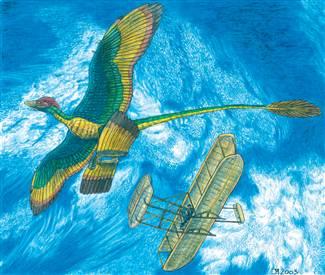
` Anyway, today I got this news report in the mail from Dory that led me to an answer to a big question I have; just how did Microraptor fly? It couldn't splay its legs out to the side, so how did it use all those flight feathers on its hind legs and feet?
` Looks like ol' Sankar Chaterjee finally figured it out! (It's about time, Mr. Chatterjee!)
` Stop licking me, you cat! Sorry. Anyway, this picture kind of says it all:


` Aha! The feathers on its feet could have created a slanted airfoil! According to MSNBC's article:

Since they couldn’t extend their hind wings directly behind the front wings, Microraptors probably held their feet lower than their arms, a more aerodynamically stable configuration, Chatterjee says. From the side, they would have looked like a staggered biplane.

After running this wing configuration through a computer simulation, the researchers determined that Microraptors got around like many small forest birds do today.

After reaching a high branch or tree top, it would hop off, diving head first until it picked up enough speed to create lift on its wings. Once it had lift, it could swoop upwards and land in the branches of another tree some 15 to 20 feet away.

Since it didn’t have to flap its wings to fly, this mode of transportation was very energetically efficient for the dino.

“It mainly glided, but probably had to flap a little during takeoff and landing, or in case of an emergency,” Chatterjee told LiveScience.

` Yep, so it looks like someone finally figured out how those four wings worked together! Why I got that piece of information from Dory first and not Nature, stumps me.
` Naturally, MSNBC is not a very good source for scientific news. For example, there's a link to an article on this page where bigfoot is taken seriously! Of course, bigfoot's been 'over with' for decades - we already know where 'sasquatch' comes from, etc.
` Also on MSNBC, there's an even weirder interactive thing called 'Did Dinosaurs Really Die Out?' This is a real laugh - read carefully:

Using cladistic taxonomy, scientists attempt to construct a "family tree" for animals. When it comes to birds, it's hard to tell where the dinosaurs end and birds begin.

The debate centers on this claim: Birds did not merely evolve from dinosaurs.

They are dinosaurs.

` Pardon me for being informed on the subject, but when Tyrannosaurus evolved from a dinosaur, it didn't stop being a dinosaur! When Archaeopteryx evolved from a dinosaur, it also stayed a dinosaur. All primitive birds were dinosaurs. Since modern birds evolved from primitive birds, they are also dinosaurs!
` A Velociraptor evolved from a primitive dinosaur that lived 140 million years before it did... and yet it was still a dinosaur! A modern eagle evolved from a dinosaur similar to Archaeopteryx about 160 million years ago! We didn't stop being mammals just because the first ones lived over 200 million years ago! One's heritage cannot wear off!
` Still, I don't know what laymen think of these things, but that's a new one to me: Anyone who understands evolution knows that we ourselves are super-intelligent endothermic, legged fish on a very basic level. For some reason, this tends to surprise some people.
` Can't imagine why.
` Then again, when you keep reading, 'the controversy'
completely changes, saying 'what if birds are actually not dinosaurs, but similar reptiles?'
` Ah, that's different. Still entirely nonsensical, but different. Very old and stuffy pseudoscience.
` I've just finished writing to Dory about another article she sent me with this Feduccia character who says that; 'Since Cretaceous feathered dinosaurs lived side-by-side with birds, how could birds have evolved from them?'

` Like... huh? Birds are not thought to have evolved from Cretaceous dinosaurs! They are thought to have evolved from the bird-like dinosaurs that lived before the Cretaceous period (along with Archaeopteryx), which would explain how so many varieties of feathered dinosaur could live side-by-side as the coelurosaur 'family' tree branched out.
` In other words, birds were but one branch of dinosaurs with feathers, and they just happened to have adapted flight capabilities to help them survive. Perhaps, that's what has served them so well since then; for some reason, they are the only dinosaur lineage alive today.

` Really, Feduccia's pseudoscientific ramblings have many eyes rolled at them in mainstream science - the only entity to widely publicize his ideas is the mass media. *Cough* MSNBC!* *A-hem!* *Discovery Channel!*
` And Butters, will you stop licking my hands?

` Er, what was I saying? Oh yes, t
here's also some exciting news about pterosaur flight, concerning how the pteroid bone on the wrists of pterosaurs would logically have to have been positioned:

"We discovered that lift is greatly increased if the pteroid bone pointed forwards in flight, not inwards as had been previously believed. This had the effect of expanding the skin-like forewing in front of the arm," Wilkinson told Discovery News.

` Yeah, I know... it's from the Discovery Channel, though this proposal has been physically demonstrated in a wind tunnel, at least. I'm no genius, but this is far from anything to get worked up over.

The high lift would have been vital in allowing the largest pterosaurs to take off and land, in a similar way that flaps work on aircraft wings.

` Flaps!? Excuse me, but flaps are on the trailing edge of a wing! In fact, these things are more or less analogous to the leading edge droop of an airplane! In fact, they're actually more like slats...
` Thank goodness for living with an aerospace engineer.

Large pterosaurs would have been able to take off simply by spreading their wings while facing a breeze. The leading edge flap would also have slowed landings, acting as an airbrake.

"It would have also served as a control surface during normal flights. For example, flexing one pteroid while extending the other would have increased lift on one wing, thereby initiating a roll," wrote the researchers.

` Once again, you can find more information on this topic elsewhere, including Matt Wilkinson's CGI animations, which don't seem to come up at all on my computer, unfortunately.
` Stop licking, pestilant cat!
What else? There's a bunch of stuff I found in Nature. Apparently, insects that are smaller than water-stiders have a way of riding a meniscus!

...insects that are just a few millimetres long deform the surface of the water with their legs, creating forces that shoot them to the top of the watery hill.

The insects are taking advantage of the same effect that causes pieces of cereal to come together in a bowl of milk, says Bush. Objects that deform a liquid and increase surface tension tend to attract each other once the deformed regions overlap, because this minimizes the overall amount of deformity, and therefore tension.

` Does that not sound insane? Ah, but it is the kind of insanity I like - the insanity of physics!

Bush and Hu studied three insect species: Mesovelia and Microvelia, which walk on water as adults, and larvae of the beetle Pyrrhalta, which perform a similar trick. They used high-speed video to capture the bugs in action, and then analysed the performance. They report the results in Nature 1.

The insects all use their legs to pull the water's surface up at the front and rear, while pressing downwards with their middle segments. Insects that live on ponds and puddles tend to have bodies that are generally water-repellent. But the insects in this study possess retractable 'wetting' claws that attract and hold the water's surface, allowing them to pull it upwards and out of shape.

The uplifted bit of water under the insect's foot then becomes an area of particularly high tension, as is the portion of the puddle's meniscus at the very edge, where it is steepest. Like bubbles on the surface of a glass of champagne, these two areas of high tension attract each other in order to lower the overall tension of the water surface. This attraction pulls the insect to the top of the hill.

"They scamper onto the menisci and are sliding down under gravity, then they lock into position and travel up it," says Bush.

Bush adds that the insect's front legs are mostly responsible for the effect. Their middle legs press down to support their weight and prevent them sinking, while the rear legs pull upwards again for balance, preventing the insect from flipping over in a backwards somersault.

` Butters, that's enough! Ah yes, insects surfing via water tension. But I get the distinct feeling that I am forgetting something...
` Oh yes, Dory's also linked me to more transcripts about the Hobbitses! Or Ebu Gogo. Well, Homo floresiensis - whatever you want to call them. From Australia's ABC radio show The World Today:

MIKE MORWOOD: So we�re not talking about a single aberrant pathological individual, we�re talking about a whole population.

MICHAEL VINCENT: This confirms your original theories?

MIKE MORWOOD: Theories? Our original description of what we found and the fact that the hominid remains we found were so different from modern humans and from homo erectus, from any other species of hominid that it warranted being given a new species designation.

` I'd like to see the look on that Jacob guy's face! Sorry - entertaining these thoughts makes me grin inanely. And insanely. It's an illness!

MICHAEL VINCENT: The species� scientific name is Homo floresiensis, but amid the initial fanfare surrounding the find, they were nicknamed hobbits.

MIKE MORWOOD: Well we have er, hmmm, we have a minimum of about 54 hobbit bones that are being studied in some detail and we�ve still got more material that has not yet been seriously looked at.

MICHAEL VINCENT: You�ve got the remains of � or parts of nine bodies �

MIKE MORWOOD: That�s correct.

MICHAEL VINCENT: You could have many more?

MIKE MORWOOD: We almost certainly have many more, yes, including an almost-complete skeleton now.

` Hooray! Also;

MIKE MORWOOD: Previously we�ve argued that Homo erectus is the most likely ancestor for the Liang Bua hominids. Now it�s more likely to have been a small-bodied hominid species and what their taxonomic status may be, we don�t know, and that makes it exciting and interesting.

And also, there are what, 17,000 islands in Indonesia and we predict that some of those islands would have also been reached by early hominid populations, and you may have developed on those islands in isolation of unique human species. There are likely to be quite a number of unique human species on some of those Indonesian islands awaiting discovery.

` Well, that wouldn't be too surprising, seeing as this has happened a lot with other animals - you have lots of close relatives living on adjascent islands.
` And, at the often-dodgy Discover.com, I also gather...


Recently, the right arm bones for this individual were located at the same site, Liang Bua cave. Another jawbone, various toe and finger bones and other remains belonging to what appears to be nine individuals also were excavated.

` These can be very useful bits, actually!

"(This is) definitely a new species of human, and neither a Pygmy nor a 'diseased' modern human," said Richard Roberts, one of the study's authors. "This is the main 'take home' message of the Nature paper.
"We have too much skeletal evidence for a distinctive, small-bodied and small-brained population of humans inhabiting the cave for a period of 80,000 years. No 'diseased' type of human can remain viable over 4,000 generations!"

Roberts, a professor and senior research fellow in the School of Earth & Environmental Sciences at the University of Wollongong, Australia, explained to Discovery News that the hobbits lacked chins and possessed very long arms that reached almost to their knees.

When full-grown they stood only about three feet three inches tall and had brains equivalent in size to those of today's chimpanzees.

` Yup. And as was said before, they hunted dwarf-sized Stegodon sp. (types of elephants) while Komodo dragons and rats probably scavenged on their kills. Of course, they would have also gathered whatever edible plants they could find.

The tool evidence unearthed by Brown and his colleagues includes stone flaking debris, stone cores, retouched tools and anvils.

` According to all we know, H. floresiensis had small brains, but surely they could use them better than a chimp could! (The structure of the brain seems to be a little more important than the size... this is reflected by human and chimpanzee genes.)
` However, nobody is sure exactly which ancient human species that H. floresiensis is most closely related to.
` For more detailed information, which requires you to have full access to the Nature website - being at a library helps! - there is an updated Homo floresiensis Nature Web Focus.

` There's also some technology news I thought was interesting...

Nantero presented its achievement at the Emerging Technologies Conference in Cambridge, Massachusetts. It uses rolled-up tubes of carbon to make transistors, the on-off switches that carry digital information inside computing chips: strings of the nanotubes move up and down to represent the ones and zeroes of binary code. Unlike the electrons in normal electrical transistors, these nanotubes stay in place even when a computer is turned off.

` Yes, these are not electron-based! Those nanotube bridges will stay in place even if the power is turned off!

Nantero calls its technology NRAM, which is loosely short for nanotube-based, non-volatile random access memory.

Non-volatile components, which by definition keep all data even when the power is turned off, are currently on the market in the form of flash memory cards. These hold electrons in insulated cells to act as ones and zeroes. They can be found in many portable gadgets, from MP3 players to digital camera memory cards.

And ferromagnetic RAM (FRAM) technology shows promise for making faster non-volatile components: it uses the orientation of crystal atoms to store data.

But both flash and FRAM chips wear out over time and lose the ability to store information. FRAM chips, adds Schmergel, cannot be made as small as NRAM ones.

Schmergel says that his chips could come in handy on space ships. The radiation in outer space can interfere with the electrons that store data in flash memory devices, so they have to be protected by lead. NRAM avoids this problem, providing the same computing power with much less bulk to loft into orbit.

` Yippee for nanotubes in computing technology and all that jazz... really, as you can probably tell, I don't have much time to write anything original and I must get to bed quickly before I collapse from exhaustion.
` Thank you, and good night.