Showing posts with label Technoholics Anonymous. Show all posts

Saturday, March 14, 2009

Back to my emails...

Just taking a break in my preparations for Finals Week, as I can't afford to neglect my email any longer. As usual, there's some pretty cool things as far as news@nature goes. So here I shall display the ones I have found most interesting, in the order in which I have viewed them.

Obama overturns stem-cell ban

President's executive order will allow US human embryonic stem-cell research to thrive at last.

Scientists and research advocates worldwide are celebrating the removal of rules limiting research on human embryonic stem cells in the United States, which they say have restricted the field's progress for seven and a half years.

The National Institutes of Health (NIH) in Bethesda, Maryland, is now working out policies that will allow researchers to apply for grant money from the agency to study some of the hundreds of cell lines created since 9 August 2001, when President George W.


One of the many reasons I like this Obama guy. I wonder how many thousands of unwanted embryos have been destroyed in vain when they would have otherwise been donated to researchers?
` I hope that U.S. scientists can catch up to other countries that have been studying embryonic stem cells all this time....

What else we got?

Evidence for ancient horse ranch uncovered

Traces of earliest known milking of horses in Kazakhstan.

Humans rode and milked horses as early as 3500 BC, say an international group of researchers. The findings come from ancient settlements in Kazakhstan, where horse jawbones showed signs of bridling and ceramic cooking vessels contained traces of horse milk.


Though humans have evidently had a long history with horses, dogs have been domesticated some 13,000 years B.C. or longer, as betrayed by their remains having been put in human burial sites.

Oh no, looks like some rainforests might actually compound carbon emissions!

Climate change crisis for rainforests

Drought could turn carbon sinks into sources.

The tropical forests of South America, Africa and Asia take up and release huge amounts of carbon each year. On the whole, they are a significant 'sink' for atmospheric carbon dioxide, but their future role in sequestering the greenhouse gas is uncertain.


Apparently, when vegetation dies, it releases carbon. Droughts can cause enough of the forest plants to die off, emitting more carbon than the rest of the forest can absorb! Oh bother....

And now, scientists may have to rethink what makes atoms do what they do....

Atomic nucleus takes two shapes

The squashed heart of a sulphur isotope fluctuates between different states.

Contrary to some expectations in the world of nuclear physics, researchers have found that a radioactive nucleus of sulphur oscillates between two different shapes, sometimes appearing like a sphere and other times like an American football. The result, reported this month by researchers in France, is causing nuclear physicists to rethink prevailing theories about what makes some nuclei stable and others prone to splitting apart.


I would assume that understanding this distinction may allow greater control over how one can manipulate atoms. You know, like for a new kind of nuclear power or some kind of other technology which may or may not feature 'splosions.

And here we have yet another use for genetic decoding...

Genetic test predicts eye colour

Forensic tool could help catch criminals.

Cheryl Jones

Police might soon be able to tell the eye colour of criminals from DNA recovered from crime scenes, thanks to a new genetic study.

A team of scientists led by Manfred Kayser, of Erasmus University Medical Centre in Rotterdam, has developed a method that predicts eye colour with unprecedented accuracy.


And here's another thing where our genetic past has come back to haunt us. Genes do that a lot, contrary to what you might think, though usually it seems the gene simply becomes inactive for a while before a new mutation activates it again.
` This, however, is different....

The resurrection of a disease-linked gene

An unusual tale of a gene lost, then found, during human evolution.

A glimpse into the evolutionary history of a gene linked to Crohn's disease has revealed a bizarre example of just how dynamic genomes can be.

The gene, called Immunity-related GTPase M (IRGM), seems to have been destroyed in the ancestor of Old and New World monkeys millions of years ago, only to be brought back to life again in the common ancestor of humans and great apes when a retrovirus lurking in the genome inserted itself into the gene.

Interesting. So, from what I know, a retrovirus is a carrier of genetic information, which replicates itself by inserting its RNA into a host cell and reverse-transcripts it into DNA, and it winds up becoming part of the cell's DNA.
` If it's a germ cell, it gets passed on into the next generation. I wish I remembered exactly how it works, though I don't have time for any more research.
` Apparently, this disease mutation somehow got into a retrovirus which carried it all over the place until it wound up settling down in the ancestors of humans and our closest ape relatives.

Bear in mind that my memory would be partly refreshed if I were able to access the rest of the article.
` *Sigh*. It's sad how much one can forget over... a decade. Anyway.... here's something I can understand better.

Microbicide protects monkeys from HIV-like virus

Gel may fight virus by suppressing counterproductive immune responses.

A microbicide made from glycerol monolaurate — an ingredient in some foods and cosmetics — can protect female monkeys from contracting an HIV-like virus, researchers have found. The compound may act by suppressing an unfortunate immune response that helps the virus rather than fights it.


I believe I've brought this one up before, haven't I? Indeed, it was this particular immune response that caused the virus to thrive rather than be injured!

Cutting calories may improve memory

Elderly people benefit from caloric restriction.

Cutting calories by 30% for three months has boosted memory and reduced insulin concentrations in a group of healthy elderly people.

Previous research on the possible benefits of calorie restriction has yielded mixed results.


I'm growing impatient to know whether or not any benefits from lower energy intake will be found....

Friends dis-united?

Models of behaviour are often simplistic but can guard against false assumptions.

"Why are all the black kids sitting together in the cafeteria?" psychologist Beverly Daniel Tatum asked in a book of that title in 1997. Her answer – that black kids need to stick together to develop a positive racial identity in the face of negative stereotypes – predictably divided opinion.

Uh-oh! I hope Dr. Nociceptor doesn't get any ideas....

Old plutonium found in dump

Weapons-grade material discovered at Hanford nuclear site.

The clean-up of a decommissioned US nuclear weapons plant has unearthed one of the oldest known samples of man-made plutonium.

Workers found roughly half a gram of weapons-grade plutonium-239 (Pu-239) in an abandoned safe at the Hanford Site in rural Washington state.


Oh yeah, quantum teleportation. It's very difficult to control, but it is possible to get tiny individual particles to jump from one place to another.
` I have no recollection of how this is done, though I do remember that it only works on single particles, and inconsistently at that. In other words, transporting objects this way does not seem feasible.

Atom takes a quantum leap

Ytterbium ion is the first element to be teleported over a distance.

Researchers have teleported a single ion of the element ytterbium over a metre in distance, shattering previous records. Photons have gone further but teleportation of matter has only occurred between ions in the same trap over a few micrometers.


Darn, I wish I could read the rest!

Same here:

Brain imaging measures more than we think

Anticipatory brain mechanism may be complicating MRI studies.

Popular brain-imaging techniques may be painting a misleading picture of brain activity, according to a new study.

Scientists using techniques such as functional magnetic resonance imaging (fMRI) make the assumption that blood flow into a particular brain region is directly linked to the amount of activity in the cells of that region.


Or... or... what else?

Hey, this is cool;

Cheating bacteria could treat infections

Freeloaders could help their hosts by undermining microbe cooperation.

Infections could be treated by adding more bacteria, say researchers who have shown that cooperation between microbes is undermined outside the bounds of the Petri dish by a few 'cheats'.

Similar to colonies of social creatures such as ants, bacteria can rely on a simple solution to the difficulties of surviving in harsh environments — cooperation.


Mua ha ha! It appears they are working to turn hostile bacteria on themselves!

$630-million for push to eradicate polio

Gates Foundation leads donors promising cash for vaccination and research.

The global drive to eliminate the last pockets of polio infection is to receive a boost of more than half-a-billion dollars from international donors. The Bill & Melinda Gates Foundation, Rotary International and the governments of the UK and Germany this week pledged $630 million over five years for a massive final push to eradicate the crippling disease.

Dinosaur fossils suggest speedy extinction

Arctic find challenges the idea that the massive reptiles declined slowly.

Fossils uncovered recently in the Arctic support the idea that dinosaurs died off rapidly — perhaps as the result of a massive meteor hitting Earth. The finding contravenes the idea that dinosaurs were already declining by this time.

I've heard of a nanoscale needle that serves as a radio - now this:

Tiny springboards detect viruses in fluids

Wobbly cantilevers 'feel' pathogens lock onto their targets.

Viruses can now be detected directly in fluids, thanks to microscopic diving boards that vibrate when the pathogenic particles stick to cellular proteins. The findings could eventually lead to better blood tests and more sensitive ways of measuring whether new drugs are binding to their targets.

Does that not blow your mind?

And here's something even more amazing:

Scientists weave invisibility cloak

Metamaterial sheet shields objects from prying microwaves.

Scientists in the US have made a sheet that can be draped over an object to render it 'invisible' — albeit to microwave radiation rather than visible light.

The new cloak works for a range of microwave frequencies.

Last but not least... something which has nothing to do with science but is worth mentioning at least. This came from Sometimes Saintly Nick... behold... Babeh Kitteh and Babeh Deer!


The cuteness will paralyze your will! Resistance is futile!

Thursday, February 05, 2009

Spoony finally checks her email!

My inbox says I have 686 unread messages.

It's been a while - long enough for gmail to have been changed drastically since last time I've checked my email.

` Here is the first message that might make good blog content.

It's a link to a review of a book about how to teach morals to robots! Good luck with that, dude.

And what's this? An ankylosaur skull was scientifically studied and it was published, which is fine, except it's terrible because bones are thought to have been smuggled from the Gobi Desert and oh no, the world's gonna end!

"It is totally inappropriate to publish on this specimen; it is stolen patrimony," says Mark Norell, curator of vertebrate palaeontology at the American Museum of Natural History in New York, who does field work in Mongolia and China.
I never knew Mark Norell was such a tightass! Nor this guy, who I think looks funny:
Philip Currie, a palaeontologist at the University of Alberta in Edmonton, Canada, says that publishing work about such fossils only encourages the raging illegal trade. "This really flags a horrendous problem in Mongolia, where a frightening number of specimens are smuggled abroad," says Currie.
Oh, it's such a tragedy that someone actually found the damn fossil and described it so we can all know about it instead of it going completely unrecognized while sitting in someone's living room!

Okay, do you think that's enough bitter sarcasm? That's great because it just so happens I have to go right now, to bed, but before I do...

Recently discovered toads with pretty colors! Colors!!

Thursday, January 11, 2007

The Antikythera Anachronism?

` The article I am referencing due to lack of additional time to study:
` In search of lost time: The ancient Antikythera Mechanism doesn't just challenge our assumptions about technology transfer over the ages — it gives us fresh insights into history itself - Nature News editor, Jo Marchant.
` I had always wondered about this thing.... Apparently it was discovered over a hundred years ago in 1902, but it has not gotten its deserved attention from historians, scientists and engineers - not to mention, the general public.
` So... what does it look like? Lucky you, there are plenty of pictures to ogle, such as this one:


` Barring that, I really enjoyed Jo Marchant's description for its own sake:

It looks like something from another world — nothing like the classical statues and vases that fill the rest of the echoing hall. Three flat pieces of what looks like green, flaky pastry are supported in perspex cradles. Within each fragment, layers of something that was once metal have been squashed together, and are now covered in calcareous accretions and various corrosions, from the whitish tin oxide to the dark bluish green of copper chloride. This thing spent 2,000 years at the bottom of the sea before making it to the National Archaeological Museum in Athens, and it shows.

But it is the details that take my breath away. Beneath the powdery deposits, tiny cramped writing is visible along with a spiral scale; there are traces of gear-wheels edged with jagged teeth. Next to the fragments an X-ray shows some of the object's internal workings. It looks just like the inside of a wristwatch.

This is the Antikythera Mechanism. These fragments contain at least 30 interlocking gear-wheels, along with copious astronomical inscriptions. Before its sojourn on the sea bed, it computed and displayed the movement of the Sun, the Moon and possibly the planets around Earth, and predicted the dates of future eclipses. It's one of the most stunning artefacts we have from classical antiquity.

` It truly seems out of place, being not only the first geared mechanism known, but also being over a thousand years ahead of Europe's invention of astronomical clocks. Nobody knows who first invented them, nor has anyone found any similar artifacts from that time.
` Why, if someone made such an amazing device, was this knowledge not preserved through the ages? It was truly an amazing advancement for ancient technology, though strangely, it has not been widely recognized as such in the modern world.
` To see just how sophisticated this device really was, a retired former curator at the Science Museum in London by the name of Michael Wright decided to reconstruct what it must have been like before it had spent those two millennia being corroded by salt water.
` Marchant describes his work:

The mechanism is contained in a squarish wooden case a little smaller than a shoebox. On the front are two metal dials (brass, although the original was bronze), one inside the other, showing the zodiac and the days of the year. Metal pointers show the positions of the Sun, the Moon and five planets visible to the naked eye. I turn the wooden knob on the side of the box and time passes before my eyes: the Moon makes a full revolution as the Sun inches just a twelfth of the way around the dial. Through a window near the centre of the dial peeks a ball painted half black and half white, spinning to show the Moon's changing phase.

On the back of the box are two spiral dials, one above the other. A pointer at the centre of each traces its way slowly around the spiral groove like a record stylus. The top dial, Wright explains, shows the Metonic cycle — 235 months fitting quite precisely into 19 years. The lower spiral, according to the research by Edmunds and his colleagues, was divided into 223, reflecting the 223-month period of the Saros cycle, which is used to predict eclipses.

To show me what happens inside, Wright opens the case and starts pulling out the wheels. There are 30 known gear-wheels in the Antikythera Mechanism, the biggest taking up nearly the entire width of the box, the smallest less than a centimetre across. They all have triangular teeth, anything from 15 to 223 of them, and each would have been hand cut from a single sheet of bronze. Turning the side knob engages the big gear-wheel, which goes around once for every year, carrying the date hand. The other gears drive the Moon, Sun and planets and the pointers on the Metonic and Saros spirals.

` If this is not enough for you, there are also photos of the front and rear of the device that you can readily view. Now, looking at these, you might ask; in the first century, who could have made such a wonderous device as this? There are, unfortunately, no inscriptions to tell us who it could have been - however, there are a few clues as to when it was built.
` Clue #1: In the 1970's, Jacques Cousteau found coins at the site of the shipwreck which were made a bit after 85 B.C. And, according to the Edmunds 2000 paper, it could had been used for perhaps 15 to 20 years before that. So, it falls somewhere in the early first century B.C.
` Clue #2: This ship had been carrying statues, silver coins from Pergamon and Rhodes-style vases, traveling the middle of a shipping route from east to west Aegean, probably headed for Rome where Greek art, philosophy and technology were well-appreciated.
` Apparently, Rhodes was like the astronomy capital of the Roman empire, and in the first century B.C., Posidonius had an astronomy school going there.
` Clue #3: The first century Roman lawyer/consul, Cicero, who studied on Rhodes, wrote in De Natura Deorum II that his friend, Posidonius himself, had 'recently' made an instrument "which at each revolution reproduces the same motions of the Sun, the Moon and the five planets that take place in the heavens every day and night".
` However, since the device has been dated to have been built after that was written, it couldn't have been Posidonius'. Even so, there has apparently been another, which I'll get to in a moment.
` Evidently, this Antikyhtera mechanism wasn't completely unique, though there evidently weren't many of them around. So, who built it? According to Edmunds, it was apparently inspired by the work of the great astronomer Hipparchus (he worked in Rhodes from 140 B.C. until his death in 120 B.C.), who was the reason Posidonius had started an astronomy school on Rhodes.
` The logic behind the assessment is this:

One of the wheels connected to the main drive wheel moves around once every nine years. Fixed on to it is a pair of small wheels, one of which sits almost — but not exactly — on top of the other.
` The bottom wheel has a pin sticking up from it, which engages with a slot in the wheel above. As the bottom wheel turns, this pin pushes the top wheel round. But because the two wheels aren't centred in the same place, the pin moves back and forth within the upper slot.
` As a result, the movement of the upper wheel speeds up and slows down, depending on whether the pin is a little farther in towards the centre or a little farther out towards the tips of the teeth (see illustration on 'Archaeology: High tech from Ancient Greece').

The researchers realized that the ratios of the gear-wheels involved produce a motion that closely mimics the varying motion of the Moon around Earth, as described by Hipparchus. When the Moon is close to us it seems to move faster. And the closest part of the Moon's orbit itself makes a full rotation around the Earth about every nine years.
` Hipparchus was the first to describe this motion mathematically, working on the idea that the Moon's orbit, although circular, was centred on a point offset from the centre of Earth that described a nine-year circle. In the Antikythera Mechanism, this theory is beautifully translated into mechanical form. "It's an unbelievably sophisticated idea," says Tony Freeth, a mathematician who worked out most of the mechanics for Edmunds' team. "I don't know how they thought of it."

"I'm very surprised to find a mechanical representation of this," adds Alexander Jones, a historian of astronomy at the University of Toronto, Canada. He says the Antikythera Mechanism has had little impact on the history of science so far. "But I think that's about to change. This was absolutely state of the art in astronomy at the time."

Wright believes that similar mechanisms modelled the motions of the five known planets, as well as of the Sun, although this part of the device has been lost. As he cranks the gears of his model to demonstrate, and the days, months and years pass, each pointer alternately lags behind and picks up speed to mimic the astronomical wanderings of the appropriate sphere.
Almost everyone who has studied the mechanism agrees it couldn't have been a one-off — it would have taken practice, perhaps over several generations, to achieve such expertise. Indeed, Cicero wrote of a similar mechanism that was said to have been built by Archimedes. That one was purportedly stolen in 212 BC by the Roman general Marcellus when Archimedes was killed in the sacking of the Sicilian city of Syracuse. The device was kept as an heirloom in Marcellus' family: as a friend of the family, Cicero may indeed have seen it.

` Indubitably, this is true: In De Re Publica, Cicero mentioned this device built about 150 years previous by Archimedes, which was demonstrated to him by Gallus: "And when Gallus moved the globe, it was actually true that the moon was always as many turns behind the sun on the bronze contrivance as would agree with the number of days it was behind in the sky. Thus the same eclipse of the sun happened on the globe as would actually happen."
` So, what happened to these devices? Perhaps they were destroyed because they were a) not much appreciated by common folk, and b) made of bronze, the perfect material for making weapons and other things and valued more as such. This would also explain why nine of the Athens museum's paltry ten major bronze sculptures were found in shipwrecks. As Wright puts it; "We only have this because it was out of reach of the scrap-metal man."

` Perhaps such technology had been carried along after all - a Byzantine sundial from the sixth century has four gears left and may have had at least eight for use as a model to keep track of the sun and the moon.
` In the eighth and ninth centuries, the rise of Islam resulted in Greek works to be translated into Arabic - perhaps they had read of such devices? In 1,000 A.D., al-Biruni described a device similar to the Byzantine sundial, which he called a "box of the moon". There is also a seven-geared astrolabe at the Museum of the History of Science in Oxford that models the sun and moon dating from 1221 or 1222, inscribed in Arabic.
` And yet, the Antikythera device is much more complex than those until the rise of clockwork devices in Western Europe, including St Albans clock (made by Richard Wallingford) from 1330, which models the motions of the sun, moon and planets. In addition to that, the clock Giovanni de'Dondi built in Padua, Italy, displays the eclipse cycles. They are so grandiose that the portion that tells time "seems incidental".
` So, were they discovered apart, or was the tradition passed down from the Moslems? Well, since clockwork mysteriously appeared in Europe right as their knowledge had spread out to Europe after the fall of Baghdad, it seems logical to attribute the clockwork to them. On the other hand, skills to build those things are generally left out of such texts, and so anyone relying on them would have to work very hard to make it work right.
` Also, if this tradition had been passed down through the generations, then why did the technology develop further over the years? The Antikythera mechanism was wildly complex while its 'descendents' did not live up to its reputation. Considering that medeival Europe's introduction to clockwork took off, introducing such new devices as clocks, why did this not happen in Greece?
` According to a historian of sciences at Imperial College, London, Serafina Cuomo, says that the Greeks just weren't that interested in making accurate timepieces. They made many devices powered by clockwork, hot air and water, but instead of making clocks or steam engines, they used them as demonstration models of philosophical principles. Philosophy, says David Sedley of the University of Cambridge, was what was really important to their entire culture.
` Such devices also may have indicated social status; amaze your friends and colleagues to earn respect! And, to up the demand, Romans also hungered for such Greek philosophers and their devices.
` Therefore, such mechanisms may not really have been built in order to further science so much as serve as important cultural works, demonstration of their cutting-edge astronomy as well as earning prestige. If you were to improve upon them, you would basically be building a better status symbol rather than seeing if it could do something they had no pressing need for, such as knowing exactly which minute on the hour it was: Their water clocks were good enough.
` And as for steam engines and other devices that could replace human labor, it may not have occurred to many a Greek to invent such things, as they also would have been superfluous: Why build a robot to do your work for you when you already have human slaves?
` Another reason why they did not invent mechanical clocks is probably because they lacked an important idea that the medeival Europeans used to make clocks work unaided - weights. Their astrological clockwork devices were powered by dripping water, which can only drive so many gears: This is why the Antikythera Mechanism apparently had to be cranked by hand.

` This whole thing makes me wonder; what if all our records from today were lost? What would people from thousands of years in the future make of our artifacts? The cars would all have rusted, our computers would have disintegrated... would anyone actually know that we successfully went to the moon in the 20th century?
` Without records, history is very hard to decipher. When the library of Alexandria was burned down, what insights and documents on the way of life were destroyed? Thank goodness we have plenty of records today... though most of them are electronic and therefore susceptible to power outages and gigantic magnets. If a giant magnet were to land on earth and erase all hard drives on earth, we would lose a gigantic percentage of information (mostly junk, but still...).
` Hmmm. Well, I'm rambling again. Yeah, I'm sleep deprived. Got a long drive ahead of me. G'night.

Sunday, January 07, 2007

Super Reflective Octopus Skin (in an attempt to clear out the 'front page')

` No kidding, I'm just posting this in order to push the lowest picture post 'below the bottom' of my front page so that I can post an all-new one without overwhelming people's computers. ...After about three power surges of late. Damn wiring.
` I've also just worked on a very long post, mentioned at the bottom of this one, which has precluded me from working on this one. That's my story and I'm stickin' to it.
` In other news, I liked this article, which is long gone on the Nature website:

Octopus skin yields bright discovery

Katharine Sanderson

Natural proteins act as super reflectors. [In pretty color-o-text-vision!]

The molecules that make octopus skin so successful as a dynamic camouflage could provide materials scientists with a new way to make super-reflective materials.

Octopus, squid and cuttlefish have developed sophisticated skins so they can hide in an ocean full of hungry predators. Roger Hanlon at the Marine Biological Laboratory, Woods Hole, Massachusetts and colleagues took a close look at this skin and identified a new group of proteins with remarkable properties.

Hanlon's team discovered that the bottom layer of octopus skin, made up of cells called leucophores, is composed of a translucent, colourless, reflecting protein. "Protein reflectors are very odd in the animal kingdom," says Hanlon, who is a zoologist.

What's even more odd is just how reflective these proteins are — they reflect all wavelengths of light that hit at any angle. "This is beautiful broadband reflection," Hanlon told the Materials Research Society at their meeting in Boston last month.

The result is a material that looks startlingly white in white light, and blue in the bluish light found beneath the waves. "These cells also match the intensity of the prevalent light," says Hanlon's research associate Lydia Mathger. All this helps the creatures to blend into their surroundings.

Closer inspection of a cuttlefish shows that some parts of the skin have enhanced reflective properties thanks to flat platelets called iridophores in the layer lying on top of the leucophores. In the brightest spots, the number of iridophores matches the number of leucophores one for one.

"The flat platelets are enhancing the brightness of the whiteness," Hanlon says. But just how they're doing that is unclear. "These are very complex 3-D cells," Hanlon says. They require further investigation, he says.

Ryan Kramer, at the Air Force Research Laboratory in Ohio, is investigating reflectin, the only known reflective protein that has been fully genetically sequenced. Hanlon's work does show that leucophores are proteins, says Kramer. Perhaps they are themselves a type of reflectin.

Once the proteins involved and their optical properties are fully understood, there could be applications far more diverse than simply mimicking an octopus's camouflage, says Hanlon. Better optical fibres could be made, for example, with super-reflective compounds.

Hanlon sees his discoveries as a call to arms for materials scientists to find applications for the bounty being discovered by zoologists. He's sure they'll find a use for it: after all, he says, the military is always interested in playing with light.
` Yes, and making themselves invisible! Mua ha ha haaaa! Then when someone blows you away, you might not notice them if they're in the open! ...Maybe. Well, I've got to get going. If you'd like to read something slightly more original and intelligent, I recommend this other post from just now!

Monday, November 06, 2006

An honest-to-goodness Space Roach Motel!

` I've stumbled across an old draft from July I didn't even know I had! Let this be a 'bonus post' to go with the upcoming Halloween post I've been neglecting to work on:

` This is basically the news from Heidi Ledford (probably a bad paraphrasing of a Nature article published online: 13 July 2006; | doi:10.1038/news060710-10):

` A miniature inflatable space hotel, filled with cockroaches and Mexican jumping beans, was launched into space from Russia on an ICBM called Genesis I on July 12. Nine hours after the launch, Bigelow Aerospace reported that the hotel had expanded, watermelon-like in shape, allowing the hotel's 'guests' to crawl throughout the 4-meter wide enclosure 550 kilometers above the planet.
` This is just one step in the process of making U.S. hotelier Robert Bigelow's dream come true. He would like to create a station that can house both researchers and people on vacation! And how? Make it inflatable - that way it's not too heavy to put up there!
` Genesis I was merely 1,360 kilograms in weight and only half its size when collapsed on earth. When it was in place, compressed air was released to fill it in. It's possible, says Bigelow, that his team may be able to make a structure of only 660 cubic meters with only two of his full-scale modules. In comparison, the International Space Station only has 425 cubic meters.
` Bigelow was actually inspired by NASA's TransHab project in the 1990s, which never came to fruition due to budget cuts. While it was in progress, however, Constance Adams and her team at NASA discovered that materials such as Kevlar could be used to prevent a 2cm meteoroid from puncturing it. Today, Bigelow uses over 40 cm of various material layers in his modules, including synthetic ceramics.
` So, they should be very well sheilded from a lot of space debris. But how long will they hold up? UV radiation tends to degrade synthetic materials. Also, folding something that thick very tightly could cause the outer surface fibers to be stretched and the inner surface would be crunched.
` Even so, inflatable structures would be a huge advantage due to the fact that the loads are so light and compact, and there would be considerably less work and fuel involved with getting these things into space.
` There are already plans for the launch of Genesis II later on this year. Though Bigelow will not send up people, he is willing to send up photos of them for $295. Further on down the road, though, he is having 50 million dollar race for a space orbiter that can carry seven people by 2010.

` As this draft was so old, I'm now wondering what else they've gotten up by now....

Tuesday, July 11, 2006

News: Biofuels, mammoth hair, addiction-curing brain damage and Van Gogh's solving of turbulence!

` Hey, let me just give ya a few highlights from Nature's science news, shall I? With no cut-and-pasting! Just because I like you!

` Apparently, corn and soybean fuels are not going to be used because there aren't enough plants to make much of an impact in the use of oil - especially when you consider that people are expected to eat most of them to begin with. Switchgrass, on the other hand, seems to be better - ethanol can be made from its dense cellulose, and no natural habitat or food resources would need to be sacrificed.
` On top of this, a report by the US Department of Energy (Friday, July 7) says that cellulosic ethanol and other biofuels combined could displace 30% of the US vehicular fuel by the year 2030.

` Mammoth hairs of varying shades have been found, but are their true colors preserved? It is possible that some mammoths really were light-colored, says Michael Hofreiter of the Max Planck Institute for Evolutionary Anthropology.
` He and his colleagues found a gene called Mc1r, from a segment of DNA they extracted from a 43,000 year-old mammoth thighbone. All mammals - including elephants, of course - have this gene, and it controls the level of pigment that can be created. In fact, they found both copies of Mc1r, and discovered that one copy could produce more proteins than the other. (How, I'm not sure, but I'll take their word for it.)
` What this means is that the mammoth had two genes for brown pigment - one was a lot better at it than the other. Usually, one strong copy and one weak copy is sufficient to produce brown hair, although animals with two weak copies have a lighter shade - as in blond humans or blond black bears.

` When a smoker's insular cortex is damaged, they stop having the urge to smoke - you cannot even trigger cravings or withdrawal in them if you tried. In fact, there is a very small chance that they will forget they ever had smoked. Apparently, the damage prevents signals from the brain's impulsive system (which involves the amygdala).
` This may provide some insight into how to help a drug addict kick the habit... of course, intentionally causing brain damage is not recommended.

` It appears that Van Gogh's paintings had swirly patterns that look a lot like Kolmogorov scaling - in other words, pictures of what turbulence looks like! Look at Starry Night, Road with Cypress and Star and Wheatfield with Crows - these contain visual eddies. They were also painted when Van Gogh was particularly manic.
` When he was taking potassium bromide, to calm him down after he cut off his ear, his famous self-portrait shows no such thing.
` Other turbulent paintings, such as Edvard Munch's The Scream, do not fit Kolmogorov's theory nearly as well.
` Though, Van Gogh is not alone - Jackson Pollock's drip paintings (like this one) are full of fractals. Strange.

` Well, there ya go. I'm going to abandon the computer now to pounce on Lou because he's lying prone on the couch. I just love it when he does that. All vulnerable and stuff... Grar.

Sunday, July 09, 2006

Slimeware?

` My life continues to be groovy. I was walking back to our apartment an hour or so ago when God (no, not the last God!) gave me some bread! Awesome! I've been meaning to try divine toast!
` Last night, I hung out with Dandruff at his dad's most awesome house where I played the piano and then we checked out this ancient Uncle Wiggily game. The cards were really non-sequitur-sounding.
` (I knew I'd heard of a pipsessiwa in a game before, but my Dad had told me I was crazy. Anyway....)
` Dandruff told me about an encounter with a crazy guy (who apparently works at Boeing) while he was out walking his dog. The guy wouldn't stop talking, though at least he didn't say anything about killing people with his 'magic wand'.
` Meanwhile, there were raccoons outside on the porch - getting into fights and such - and I witnessed the first time his dog apparently noticed them at all. At about 23:00 or so, we bought some ice cream and then passed one of the raccoons on our way down to the woods to eat it by the light of the trees.
` Trees, unfortunately, do not emit much light, but our eyes eventually adjusted. Unfortunately, there were no bears or naked lawyers, though my pants were attacked by my ice cream.

` I have some material from Nature that is now impossible to view... except for on this blog! It's about bacterial fuel cell technology.

` Read it. Because I said so!

Nature 441, 277–279 (2006)
Microbiology: Batteries not included: Circuits of slime
Charlotte Schubert
Charlotte Schubert is senior News and Views editor for Nature Medicine

C. DARKIN

The left-hand side of Peter Girguis's lab is a mucky place. Dried mud flecks benches, beakers and scales, and buckets of slime clutter the floor. Fresh ooze is flown in regularly from California. A skein of pipes fed by a 2,000-gallon tank of sea water in the basement keeps everything moist. On the floor, wires gush out of dismembered plastic cocoons, and electrodes poke out of various tanks.
The messy workplace is a design shop for electrical generators. This summer, microbiologist Girguis and his colleagues at Harvard University in Cambridge, Massachusetts, will shove graphite electrodes, like those used in this lab, into the sea floor of Monterey Bay in California. The current that flows between the electrodes will power a suite of scientific instruments, including a wave and tide meter, and a fluorometer that measures levels of chlorophyll in sea water.
Girguis's work depends on the fact that when bacteria respire they pull electrons off organic debris. Catch those electrons on an electrode that is hooked up to a second electrode in free water, say, or in air, or in another layer of sediment where the microbes use a different sort of electrochemistry (see page 274 of Nature) — and the electrons will flow from the first to the second electrode. That gives you a current with which you can power things.
This technology would transform the world if it ever became reliable and could be used on a large scale.

The currents produced by these microbial fuel cells are small, but their potential, in the non-voltage sense, may be surprisingly large. After all, microbes can produce electrons from sediment, sewage, food scraps or pig slop. Girguis, a self-confessed gearhead, takes some delight in a simple demonstration of their current-generating abilities using just a bucket, some hardware-store supplies and a bag of cow manure.
People have been trying to harness the power of microbes in this way since the early 1900s, although with little practical success. Engineering advances and molecular biology's new tools, some of which have a home in the clean half of Giguis's lab, have allowed him and like-minded researchers to breathe life into the field.
“This technology would transform the world if it ever became reliable and could be used on a large scale,” says Bruce Rittman, director of the Center for Environmental Biotechnology at Arizona State University's Biodesign Institute in Tempe. But he admits that is still a dream. “We are quite some distance from capturing the benefits at an economic scale.” To get there, he estimates that researchers will need to produce fuel cells with power-generating abilities that are a hundred times greater than those of today's cells.
“All of microbial fuel-cell research invariably has to deal with the interface between microbes and the electrodes,” says Girguis. One approach, favoured by engineers, is to try to improve the cell's design and the materials from which the electrodes are made. Biologists, however, aspire to better understand the microbes themselves, with the aim of informing more sophisticated designs — or designing better bacteria.

Natural lighting

Fuel-cell builders have been adding electron mediators — small molecules that help electrons move around — to their systems for years to increase the current. But another way to enhance performance may be to increase the physical contact between the bacteria and the electrodes.
Last year, Derek Lovley at the University of Massachusetts, Amherst, revealed that members of a group of bacteria called Geobacter extrude protein spines, or pili, which conduct electricity2. And they are not the only ones, according to findings presented this February at a conference sponsored by the US Department of Energy, and held in Bethesda, Maryland.

Multi-talented: microbes could help remove toxins from waste water, and power the treatment plants.
B. AREY/PNNL

Yuri Gorby from the Pacific Northwest National Laboratory in Richland, Washington, reported that nanowires sprout from a range of bacteria, including the iron-breathing microbes Shewanella and the photosynthetic bacteria Synechocystis. Using Synechocystis, he and his colleagues have made a solar-powered form of microbial fuel cell. The key to the nanowires' conductivity, Gorby and his colleagues found, was the presence of certain cytochromes — electron-shuttling molecules found in bacterial membranes. Bacteria lacking the nanowires or cytochromes are poor conductors of electricity.

The power of mud: soil bacteria free up electrons as they respire. When used to induce a current between electrodes, these can light up a lamp.
P. GIRGUIS

Researchers are already thinking about how to harness the findings. Gorby's colleague, microbiologist Ken Nealson at the University of Southern California in Los Angeles, points out that Geobacter and Shewanella have evolved to transfer electrons to scraps of metal found in nature, not to an artificial electrode. Encouraging them to evolve electrode compatibility might yield a great deal of improvement. Nealson and Lovley say that ‘electrode-adapted’ bacteria could one day produce fuel cells with at least 100-fold greater power-generating abilities compared with current cells.
Such ‘improved’ bacteria might be too specialized and delicate to thrive in marine sediments. But they could be put to use in purpose-built closed bioreactor systems, where they could generate electricity by chewing up biomass. “It's the best approach we have to developing an industrial application or producing a lot of power,” says Girguis.
While the biologists extol the potential of nanowires, Bruce Logan, an environmental engineer at the Pennsylvania State University in University Park, prefers to concentrate on the chemistry and physics of the fuel cells. Logan says he hasn't seen much practical advance from understanding the biology of the microbes. “It's not clear whether we are limited by the bacteria or the physics of the system,” he says. And although he is not dismissive of the microbiologists — indeed he has just started collaborating with Nealson — he argues that “most of our improvements have been geared towards the physics and chemistry, suggesting that that is the major roadblock.”Energy on the cheap
Logan works with industrial runoff, animal waste and sewage. At least 1.5% of US electricity production goes into wastewater treatment, he says. He wants to change that equation, by developing systems that produce electricity as well as cleaning the water.

Ken Nealson thinks technologies using microbes could be improved by knowing about their biology.

P. CHANNING/USC COLLEGE
The field of wastewater treatment by fuel cells was opened up by Byung-Hong Kim, a microbiologist from the Korea Institute of Science and Technology in Seoul; Kim developed a system that didn't need added electron mediators in the 1990s3. Since then engineers, such as Logan, have worked on various ways of improving the design and the power output of these cells. Logan's most recent table-top device yields the equivalent of 15.5 watts per cubic metre of household waste water flowing through it4.
By the standards of a conventional fuel cell, such as one powered by hydrogen, that's a very poor yield. But with scale-up, Logan estimates that the waste water from 100,000 people, or a large industrial plant, could produce 0.8 megawatts, enough to power about 500 homes. Such a system would also scrub waste water of troublesome compounds such as ammonia, which is consumed by the microbes, and produce 50–90% less sludge than conventional methods.
Unfortunately, the electron-gathering anodes in Logan's laboratory systems are made from moderately expensive graphite or carbon paper, and the cathodes need to be coated with very costly platinum for the best effects. Willy Verstraete, an environmental engineer at Ghent University in Belgium, says that, extrapolating linearly from the costs of the prototypes, the capital expenditure for a full-scale plant would be five to ten times higher than it is for today's treatment plants. So the hunt is on for cheaper materials.
Logan points out that the technology does not have to be cheap, just cheaper than the current techniques. The United States already spends about $25 billion each year on domestic wastewater treatment, he says. He is working on a design of fuel cell that he says could be cost effective and scalable; he hopes this will yield ten times as much power per cubic metre of waste water as current designs do.

Power to the people

Verstraete is more cautious. “Industry is expressing a lot of interest,” he says, “but they are not putting the money on the table.” He says that companies want to see yields as high as 1,000 watts per cubic metre — and to see them in prototypes a thousand times larger than the milk-carton-sized devices now honing the technology. He sees a role for the technology in cleaning certain nitrogenous pollutants out of waste water, or chewing up effluents from the digesters that convert biomass to methane on some farms. But it's still a long road to the first microbial car (see ‘And what if it worked?’).
Meanwhile, the powering of marine instruments seems to be the application moving the fastest. Girguis's work on Monterey Bay sediments follows the lead of pioneers such as Lenny Tender at the US Naval Research Laboratory in Washington DC. Tender was one of the team that first successfully extracted current from marine sediment more than five years ago5. This summer, Tender plans to launch a microbial fuel cell that powers an acoustic device for measuring water velocity. Taking measurements every 4 hours it will consume an average of just 0.1 watts.
Environmental monitoring on the land and the ocean surface is increasingly powered by solar cells that can work for years unsupervised. The ocean floors, being abysmally short of sunlight, need a different approach, and Tender, Girguis and their colleagues think that microbial-powered electricity is the solution. This would obviate the need for battery replacement that currently drives up the costs of such studies.
“They have a lot more work to do before they can call this a real proven technology,” says James Bellingham, chief technologist at the Monterey Bay Aquarium Research Institute, who is working with Girguis. “But these guys have come very far very fast.”
Which other niche areas might be successful is less clear. For his terrestrial applications, Girguis is collaborating with an architect who specializes in new materials. Together, they plan to design LED lighting systems that can be powered by a bucket of food scraps or animal waste. He says such devices could be mass-produced for about ten dollars each and could help generate light for many of the 1.6 billion people living outside the world's electrical grid. Although such people are obvious candidates for solar power, Giguis says the microbial option has the advantage of being much less expensive to manufacture and easier to operate and repair. And it can work in the dark.
The technology need not always be cheap and cheerful. Rittman has a grant of $100,000 from NASA to design a compact microbial fuel cell that consumes human waste during a manned astronaut mission. But like many researchers in the area, he dreams of bigger opportunities on Earth. If microbial fuel cells could be adapted for the consumption of plant biomass, they could in theory produce twice the amount of electrical energy that combustion-driven generators can, says Rittman. Again, however, the best that has been done is not quite that good, and is stuck on the lab bench for now.
But Nealson, for one, is confident things can improve, especially if links between different disciplines housed in different departments can be strengthened. “Our job here is to understand how the bacteria work, and once we know that we can get together with the engineers. Then you might find out how to make the ideal fuel cell.” He laughs, “maybe it will drive itself across campus.”

References
1.
Potter, M. C. Proc. R. Soc. Lond. B 84, 260–276 (1911).
2.
Reguera, G. et al. Nature 435, 1098–1101 (2005). Article
3.
Kim, B.-H., Kim, H.-J., Hyun, M.-S. & Park, D.-H. J. Microbiol. Biotechnol. 9, 127–131 (1999). Article
4.
Cheng, S., Liu, H. & Logan, B. E. Environ. Sci. Technol. 40, 2426–2432 (2006). Article
5.
Reimers, C. E., Tender, L. M., Fertig, S. & Wang, W. Environ. Sci. Technol. 35, 192–195 (2001). Article

` Well, that's that. You read it from Nature. Now you know. And you didn't have to pay anything for it, either!
` I'm so bad.
` Actually, I'm just pressed for time. Kind of like olives being pressed for oil. Except time. Unless, of course, you work for Enron and you think that time is oil!
` ...Anyway... I've got things I need to do without even moving, such as catch up with my 300 e-mails! Tootles!

Saturday, January 07, 2006

So, now that I'm back...

` There are a bunch of random things I'd like to write about. For example, did you know that the paper 'airplane' was around long before airplanes were invented? Even weirder, back in 1867, a couple of Britons by the names of J. W. Butler and E. Edwards drew up a plan to build a giant paper 'dart' to be ridden by a person:
` It was never built, though.

` But enough with intellectual musings. As for my situation, I walked all over town, looking for apartments. Unfortunately, I dropped my pen so I couldn't take down numbers each time I came across a vacancy. (It would have been smarter just to bring my phone, anyway!)
` As it happened, there were only two apartment complexes I had come by which had a front office I could walk into: Out of those, the cheaper one charged only two hundred dollars over my spending limit for a studio!
` I presume that some of the other studio apartments being advertised are cheaper since they don't look very nice on the outside.

` Anyway, I need to go: Phil - who only just let me onto his computer as he was going to bed - is waiting on me to leave the room so that he can get some sleep.


` NEXT-DAY UPDATE: The house apartment we looked at today is so sweet - and it's only $400! In fact, I am still looking at it due to the fact that I can see it out the window!

Thursday, December 08, 2005

Electron beam hard drive technology?

` Today, I found this while skimming through one of the Nature publications and said: "Yay!" As much as I still love my Western Digital:

...Eric C. Hannah and Michael A. Brown have now been granted a US patent, filed by Intel Corporation, on reading as well as possibly writing magnetic data using a spin-polarized electron beam instead of magnetic field sensors1.
` Their concept makes use of a hard magnetic layer, sandwiched between half-metallic, soft magnetic 'spin mirrors'. At the appropriate beam energies, the mirror layers reflect electrons with minority spin polarization while being transparent for electrons polarized in the same direction as the magnetic layer. The electrons passing through the device will eventually be absorbed by the magnetic layer, and can then be detected, for example, through their optical recombination in an adjacent semiconductor layer.
` Although no proof of concept has been provided, a system like this could soon lead to the abolishment of the slow read/write heads in use today.
` Yes, I think it is time for hard drives to stop reading in microseconds and speed up to... what? Nanoseconds? Picoseconds? That leaves more time for doing other things not computer-related...

Saturday, November 05, 2005

My disastrous interview with a Boeing 787 engineer

` Now that Blogger is back up and running today, I figured I'd do a little interview in case anyone cares about the new Boeing 787 Dreamliner. Without further ado:

` I'm severely ill and feel like I've been hit with a tranquilizer dart, despite the fact that I haven't had any substances which might cause this effect since that pint of cider I had four days ago.

` I'm sitting at my computer with the man who was with me when I had the cider, the 787 engineer whom I've only referred to as 'Phil' on this blog.

` "It's all true, everything in that video," he says.

` "So," I ask, unable to really comprehend what's going on in the video, due to being in a stupor; "What makes this plane different from the previous Boeing models?"

` Phil: "This one has a ton of composites, meaning that you don't have to worry about corrosion from humidity. No bleed air is taken from the compressors of the jet engines - it's all onboard electrically powered systems that maintain the environment.

` "See, one of the problems people have when flying is altitude sickness and dehydration, which contribute to jet lag. The 787 will have more cabin pressure than normal planes - the air pressure of six thousand feet in altitude as opposed to eight thousand feet - so there will be more humidity and those symptoms won't be as bad."

` Me: "So that's a huge advantage to using the composites - they won't rust from the moisture in the cabin."

` Phil: "Actually, the main advantage is that the composite is a lot stronger and more flexible than aluminum, and there aren't many pieces in the fuselage: It's made of one-piece barrel sections instead of stringers and beams riveted together with an aluminum skin.

` "Composite's also much lighter, which allows you to have a much farther range without refueling. It'll be able to connect any two city pairs in the world, for example, Detroit to Shanghai nonstop."

` Me: "And you've been saying that it's a lot nicer on the inside, besides more normal air. There's a bunch more room and more space for your luggage..."

` Phil: "Yes, and the windows will be a lot bigger on the inside, and there are no window shades; you just turn the little dial to change the translucency. Also, the cabin lights can be adjusted to about any color, to simulate the sky at any time of day."


` Me: "And it's more convenient on the outside, too, you said something about the spiky edges on the jet engines, that it cuts down on noise?"

` Phil: "It's a lot quieter than a normal plane, and I'm not going to go into any detail. Granted, I don't know a lot of the numbers."


` Me: "Well, I'd guess not. You're a loads engineer. So, what is it that you're working on?"

` Phil: "There's honestly not anything I can tell you about what I do, at least not anything you can put online."


` Me: "Ah."

` And that was about it. It had completely trailed off by then, and there wasn't anything else I could think of to ask.

` Grah. Thank you and goodnight.

Friday, October 28, 2005

Monomolecular Wheels

` Weird! This morning I checked out my inbox extra-early to find an article in the Materials Science and Nanotechnology section of Nature publications, describing an odd kind of rolling prototype vehicle that is 3x4 nanometers in size!

` Says the article:

Their chassis is shaped like a letter H, with two axles linked by a central rod. All these units are composed of carbon–carbon triple bonds alternating with benzene rings.

The key to the nanocar is the wheels. These are made of C60 molecules attached to the tips of the axles, joined by bonds that are free to rotate.

` I am guessing that these molecules are cylinderical fullerenes, also called nanotubes.

These nanoscale molecules stick to a gold surface and, when warmed to above 170 °C, begin to move. This happens in a zigzag fashion: a nanocar travels in a single direction for a short distance, and then pivots to a new direction before proceeding again. The forward motion is always perpendicular to the orientation of the axles, which is evident from STM images in which the four C60 molecules can be clearly seen.

` According to all the tests they've pulled on these things, the wheels really are rolling forward - in fact, ones with three different axles can only spin in place like office chairs with three fixed wheels.
` James Tour's team at the Rice University in Houston are the ones who are responsible for making what may be the smallest molecular monstrosities in Texas!

Sunday, October 16, 2005

Homo floresiensis, mesozoic flight, nanotubes and tiny insects!

` The Russian State Chorus was neato! I liked the hyperactive conductor, too! They also sang 'America the Beautiful', probably because they're in our country, and they were better than any Americans I've heard!
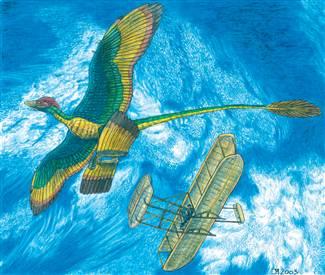
` Anyway, today I got this news report in the mail from Dory that led me to an answer to a big question I have; just how did Microraptor fly? It couldn't splay its legs out to the side, so how did it use all those flight feathers on its hind legs and feet?
` Looks like ol' Sankar Chaterjee finally figured it out! (It's about time, Mr. Chatterjee!)
` Stop licking me, you cat! Sorry. Anyway, this picture kind of says it all:


` Aha! The feathers on its feet could have created a slanted airfoil! According to MSNBC's article:

Since they couldn’t extend their hind wings directly behind the front wings, Microraptors probably held their feet lower than their arms, a more aerodynamically stable configuration, Chatterjee says. From the side, they would have looked like a staggered biplane.

After running this wing configuration through a computer simulation, the researchers determined that Microraptors got around like many small forest birds do today.

After reaching a high branch or tree top, it would hop off, diving head first until it picked up enough speed to create lift on its wings. Once it had lift, it could swoop upwards and land in the branches of another tree some 15 to 20 feet away.

Since it didn’t have to flap its wings to fly, this mode of transportation was very energetically efficient for the dino.

“It mainly glided, but probably had to flap a little during takeoff and landing, or in case of an emergency,” Chatterjee told LiveScience.

` Yep, so it looks like someone finally figured out how those four wings worked together! Why I got that piece of information from Dory first and not Nature, stumps me.
` Naturally, MSNBC is not a very good source for scientific news. For example, there's a link to an article on this page where bigfoot is taken seriously! Of course, bigfoot's been 'over with' for decades - we already know where 'sasquatch' comes from, etc.
` Also on MSNBC, there's an even weirder interactive thing called 'Did Dinosaurs Really Die Out?' This is a real laugh - read carefully:

Using cladistic taxonomy, scientists attempt to construct a "family tree" for animals. When it comes to birds, it's hard to tell where the dinosaurs end and birds begin.

The debate centers on this claim: Birds did not merely evolve from dinosaurs.

They are dinosaurs.

` Pardon me for being informed on the subject, but when Tyrannosaurus evolved from a dinosaur, it didn't stop being a dinosaur! When Archaeopteryx evolved from a dinosaur, it also stayed a dinosaur. All primitive birds were dinosaurs. Since modern birds evolved from primitive birds, they are also dinosaurs!
` A Velociraptor evolved from a primitive dinosaur that lived 140 million years before it did... and yet it was still a dinosaur! A modern eagle evolved from a dinosaur similar to Archaeopteryx about 160 million years ago! We didn't stop being mammals just because the first ones lived over 200 million years ago! One's heritage cannot wear off!
` Still, I don't know what laymen think of these things, but that's a new one to me: Anyone who understands evolution knows that we ourselves are super-intelligent endothermic, legged fish on a very basic level. For some reason, this tends to surprise some people.
` Can't imagine why.
` Then again, when you keep reading, 'the controversy'
completely changes, saying 'what if birds are actually not dinosaurs, but similar reptiles?'
` Ah, that's different. Still entirely nonsensical, but different. Very old and stuffy pseudoscience.
` I've just finished writing to Dory about another article she sent me with this Feduccia character who says that; 'Since Cretaceous feathered dinosaurs lived side-by-side with birds, how could birds have evolved from them?'

` Like... huh? Birds are not thought to have evolved from Cretaceous dinosaurs! They are thought to have evolved from the bird-like dinosaurs that lived before the Cretaceous period (along with Archaeopteryx), which would explain how so many varieties of feathered dinosaur could live side-by-side as the coelurosaur 'family' tree branched out.
` In other words, birds were but one branch of dinosaurs with feathers, and they just happened to have adapted flight capabilities to help them survive. Perhaps, that's what has served them so well since then; for some reason, they are the only dinosaur lineage alive today.

` Really, Feduccia's pseudoscientific ramblings have many eyes rolled at them in mainstream science - the only entity to widely publicize his ideas is the mass media. *Cough* MSNBC!* *A-hem!* *Discovery Channel!*
` And Butters, will you stop licking my hands?

` Er, what was I saying? Oh yes, t
here's also some exciting news about pterosaur flight, concerning how the pteroid bone on the wrists of pterosaurs would logically have to have been positioned:

"We discovered that lift is greatly increased if the pteroid bone pointed forwards in flight, not inwards as had been previously believed. This had the effect of expanding the skin-like forewing in front of the arm," Wilkinson told Discovery News.

` Yeah, I know... it's from the Discovery Channel, though this proposal has been physically demonstrated in a wind tunnel, at least. I'm no genius, but this is far from anything to get worked up over.

The high lift would have been vital in allowing the largest pterosaurs to take off and land, in a similar way that flaps work on aircraft wings.

` Flaps!? Excuse me, but flaps are on the trailing edge of a wing! In fact, these things are more or less analogous to the leading edge droop of an airplane! In fact, they're actually more like slats...
` Thank goodness for living with an aerospace engineer.

Large pterosaurs would have been able to take off simply by spreading their wings while facing a breeze. The leading edge flap would also have slowed landings, acting as an airbrake.

"It would have also served as a control surface during normal flights. For example, flexing one pteroid while extending the other would have increased lift on one wing, thereby initiating a roll," wrote the researchers.

` Once again, you can find more information on this topic elsewhere, including Matt Wilkinson's CGI animations, which don't seem to come up at all on my computer, unfortunately.
` Stop licking, pestilant cat!
What else? There's a bunch of stuff I found in Nature. Apparently, insects that are smaller than water-stiders have a way of riding a meniscus!

...insects that are just a few millimetres long deform the surface of the water with their legs, creating forces that shoot them to the top of the watery hill.

The insects are taking advantage of the same effect that causes pieces of cereal to come together in a bowl of milk, says Bush. Objects that deform a liquid and increase surface tension tend to attract each other once the deformed regions overlap, because this minimizes the overall amount of deformity, and therefore tension.

` Does that not sound insane? Ah, but it is the kind of insanity I like - the insanity of physics!

Bush and Hu studied three insect species: Mesovelia and Microvelia, which walk on water as adults, and larvae of the beetle Pyrrhalta, which perform a similar trick. They used high-speed video to capture the bugs in action, and then analysed the performance. They report the results in Nature 1.

The insects all use their legs to pull the water's surface up at the front and rear, while pressing downwards with their middle segments. Insects that live on ponds and puddles tend to have bodies that are generally water-repellent. But the insects in this study possess retractable 'wetting' claws that attract and hold the water's surface, allowing them to pull it upwards and out of shape.

The uplifted bit of water under the insect's foot then becomes an area of particularly high tension, as is the portion of the puddle's meniscus at the very edge, where it is steepest. Like bubbles on the surface of a glass of champagne, these two areas of high tension attract each other in order to lower the overall tension of the water surface. This attraction pulls the insect to the top of the hill.

"They scamper onto the menisci and are sliding down under gravity, then they lock into position and travel up it," says Bush.

Bush adds that the insect's front legs are mostly responsible for the effect. Their middle legs press down to support their weight and prevent them sinking, while the rear legs pull upwards again for balance, preventing the insect from flipping over in a backwards somersault.

` Butters, that's enough! Ah yes, insects surfing via water tension. But I get the distinct feeling that I am forgetting something...
` Oh yes, Dory's also linked me to more transcripts about the Hobbitses! Or Ebu Gogo. Well, Homo floresiensis - whatever you want to call them. From Australia's ABC radio show The World Today:

MIKE MORWOOD: So we�re not talking about a single aberrant pathological individual, we�re talking about a whole population.

MICHAEL VINCENT: This confirms your original theories?

MIKE MORWOOD: Theories? Our original description of what we found and the fact that the hominid remains we found were so different from modern humans and from homo erectus, from any other species of hominid that it warranted being given a new species designation.

` I'd like to see the look on that Jacob guy's face! Sorry - entertaining these thoughts makes me grin inanely. And insanely. It's an illness!

MICHAEL VINCENT: The species� scientific name is Homo floresiensis, but amid the initial fanfare surrounding the find, they were nicknamed hobbits.

MIKE MORWOOD: Well we have er, hmmm, we have a minimum of about 54 hobbit bones that are being studied in some detail and we�ve still got more material that has not yet been seriously looked at.

MICHAEL VINCENT: You�ve got the remains of � or parts of nine bodies �

MIKE MORWOOD: That�s correct.

MICHAEL VINCENT: You could have many more?

MIKE MORWOOD: We almost certainly have many more, yes, including an almost-complete skeleton now.

` Hooray! Also;

MIKE MORWOOD: Previously we�ve argued that Homo erectus is the most likely ancestor for the Liang Bua hominids. Now it�s more likely to have been a small-bodied hominid species and what their taxonomic status may be, we don�t know, and that makes it exciting and interesting.

And also, there are what, 17,000 islands in Indonesia and we predict that some of those islands would have also been reached by early hominid populations, and you may have developed on those islands in isolation of unique human species. There are likely to be quite a number of unique human species on some of those Indonesian islands awaiting discovery.

` Well, that wouldn't be too surprising, seeing as this has happened a lot with other animals - you have lots of close relatives living on adjascent islands.
` And, at the often-dodgy Discover.com, I also gather...


Recently, the right arm bones for this individual were located at the same site, Liang Bua cave. Another jawbone, various toe and finger bones and other remains belonging to what appears to be nine individuals also were excavated.

` These can be very useful bits, actually!

"(This is) definitely a new species of human, and neither a Pygmy nor a 'diseased' modern human," said Richard Roberts, one of the study's authors. "This is the main 'take home' message of the Nature paper.
"We have too much skeletal evidence for a distinctive, small-bodied and small-brained population of humans inhabiting the cave for a period of 80,000 years. No 'diseased' type of human can remain viable over 4,000 generations!"

Roberts, a professor and senior research fellow in the School of Earth & Environmental Sciences at the University of Wollongong, Australia, explained to Discovery News that the hobbits lacked chins and possessed very long arms that reached almost to their knees.

When full-grown they stood only about three feet three inches tall and had brains equivalent in size to those of today's chimpanzees.

` Yup. And as was said before, they hunted dwarf-sized Stegodon sp. (types of elephants) while Komodo dragons and rats probably scavenged on their kills. Of course, they would have also gathered whatever edible plants they could find.

The tool evidence unearthed by Brown and his colleagues includes stone flaking debris, stone cores, retouched tools and anvils.

` According to all we know, H. floresiensis had small brains, but surely they could use them better than a chimp could! (The structure of the brain seems to be a little more important than the size... this is reflected by human and chimpanzee genes.)
` However, nobody is sure exactly which ancient human species that H. floresiensis is most closely related to.
` For more detailed information, which requires you to have full access to the Nature website - being at a library helps! - there is an updated Homo floresiensis Nature Web Focus.

` There's also some technology news I thought was interesting...

Nantero presented its achievement at the Emerging Technologies Conference in Cambridge, Massachusetts. It uses rolled-up tubes of carbon to make transistors, the on-off switches that carry digital information inside computing chips: strings of the nanotubes move up and down to represent the ones and zeroes of binary code. Unlike the electrons in normal electrical transistors, these nanotubes stay in place even when a computer is turned off.

` Yes, these are not electron-based! Those nanotube bridges will stay in place even if the power is turned off!

Nantero calls its technology NRAM, which is loosely short for nanotube-based, non-volatile random access memory.

Non-volatile components, which by definition keep all data even when the power is turned off, are currently on the market in the form of flash memory cards. These hold electrons in insulated cells to act as ones and zeroes. They can be found in many portable gadgets, from MP3 players to digital camera memory cards.

And ferromagnetic RAM (FRAM) technology shows promise for making faster non-volatile components: it uses the orientation of crystal atoms to store data.

But both flash and FRAM chips wear out over time and lose the ability to store information. FRAM chips, adds Schmergel, cannot be made as small as NRAM ones.

Schmergel says that his chips could come in handy on space ships. The radiation in outer space can interfere with the electrons that store data in flash memory devices, so they have to be protected by lead. NRAM avoids this problem, providing the same computing power with much less bulk to loft into orbit.

` Yippee for nanotubes in computing technology and all that jazz... really, as you can probably tell, I don't have much time to write anything original and I must get to bed quickly before I collapse from exhaustion.
` Thank you, and good night.