Sunday, June 12, 2005

When a U-Haul Meets Your Train: Plus, Waterfall-Hiking!

` It's been kinda eventful laterly - thought I should tell ya.

Yesterday, Phil's college buddy, Eugene, was coming to the Everett Station - so we thought - and we showed up and the train came in and he didn't get off the train. So we were like "what the hell?" Then, Phil got a call. It was Gene.
` He explained that he was on his way here on schedule when all of a sudden, the train brakes and there's this sound, and then more braking until the train stopped. Just outside his window is this fireball - he took a digital picture and showed me. I'd ask him to give it to me and post it if I was capable of it.

[I was not able to at the time on seo-blog, so I missed my chance.]

` Well, it turned out that it was a U-Haul that was burning outside the train car - the driver had luckily got out before the train hit. I have no idea what that was all about, but all of his belongings, furniture, computer, whatever was in it, was destroyed - I saw the picture in more detail on Gene's laptop, and clearly it was a goner. While people were fleeing the car, he was sticking around to watch out the window with some other people.
` As the grass began burning around the fireball, the train was backed up, as the outer casing of the engine was the only casuality. Whoever was in charge of the train finally decided that they weren't going to put everyone on a train and take them all the way back down to Oregon - they just got another engine and took the train the rest of the way, about two hours late.
Anyway, he got here two hours late and we went to the Diamond Knot Brewery, had the bestest pizza ever (as usual), and then I went to bed.

` On the eleventh, which is technically now the real yesterday, Phil, Gene, Me, Mike, Brian, Luke, and Toby (he's from Germany! Neat!) all hiked a few miles up this mountain to a body of diarrhea-inducing water creatively named Lake 22. In the dense precipitation.
` First off, there were many stream crossings and waterfalls across the trail, though the only ones that had bridges were the ones that would knock you downstream. In several places, the water just ran down the trail itself, so it was like walking up little streambeds and even waterfalls. Joy. At one point, there was a bridge lying on the ground and a boulder in its place, which acted as a seven-foot-tall railing to keep us from going over the waterfall. At another point I'm glad the bridge was not out, because the waterfall was not exactly swimmable.
` Then, there was this open area as we were getting through the clouds and above a lot of the drizzle. When we got to Lake 22 I was thinking of maybe eating some trail mix, being that I'd bought some for the trip. Then the guys wanted to go around the lake. That's when it began to rain, like a real, Ohio light rain (RAIN!!!) instead of the typical Everett rain (drizzle).

' Even more fun, guess how we got to the around-the-lake trail? Step onto the diseased lake across three pointy little stones to a log. Walk across the that and step way down to a four-inch-wide board set just above the water level, propped across other pointy little rocks. Then go across another stone to another board and other stones until you get to the boardwalk. We were really wet though and couldn't make it around to where the patches of snow were on the other side, so we turned right around and went back. Amazingly, none of us fell in, considering we were all carrying stuff.
` Then, as it got more and more wet, more of the trail had become a river by the time we were getting down. Luckily, I was doing pretty good with the stepping stones and keeping my feet dry, an accomplishment considering I was wearing hiking sandals. (It's not a real intensive trail for the feet.) Of course, I lagged behind and lagged behind and then tripped over something just as Phil and Gene were going out of sight. Even worse, my feet got plenty wet in a four-inch-deep stream on the trail!
` Luckily, they finally realized I was missing and waited for me about a third of a mile down from where I tripped, and it took twenty minutes for us three to get down to everyone else. I guess I don't feel so bad, though, considering that the other guys are just amazing when they hike - to keep up with them, you have to jog.

` Well, anything else? Not really, other than the fact that I'm going to have another chocolate chip cookie that Phil made while EdgeWalker - who was supposed to be here tonight - gets to sleep on the floor of San Francisco's airport with no cookies.

` Ah, EdgeWalker. He went to school with Phil since age four up through college at OSU - they've been good friends, and now... EdgeWalker's plane was delayed for some reason to get to O'Hare, so he missed his connecting flight to SeaTac.
` Instead, he had to fly to San Francisco, but he can't get a flight to Seattle until morning - which comes three hours after Ohio mornings - so when the sky gets bright at 3 a.m. (an hour from now), it'll be 6 a.m. according to his biological clock! I hope he gets here before Gene has to leave tomorrow morning, as Gene was hoping to come along to see Seattle in daylight. (He did get to see it though, when the rain was letting up at sunset as we went to get dinner at Jai Thai - which we were planning to take EdgeWalker to when he got here...)


` Ah well, anyway, that's another boring life-story from me - though it's mostly boring because of the repetitive sentence structure and the fact that I really don't go out of my way to make it interesting or anything. In fact, I forget completely what I was intending to write - my fingers are just flying and I itch all over and OH PLEASE MAKE IT STOP!!!!!! Time for Benadryl - it works on itches that aren't allergies because it blocks histamine! Hooray!

Re: When a U-Haul Meets Your Train - PLUS, How To Hike Up A Waterfall!

sounds like a fun hike. cool blog. 8)

ohiochic | 25/06/2005, 08:10

Monday, June 06, 2005

Somewhat Amusing and Gross Mouse Stories

` I wanted to write this one some time back, but I didn't because I was working on another entry. They're fun! Anyhow, mice are a real pain when you have to kill them. They're pawns of our destruction (when we're not pawns of theirs, anyway), because you can't escape them. It's horrible.
` Let's see if I can still remember some of those mouse stories I was going to write (I know, I'm writing second-run things all the time around here.) These all involve Phil's poor mother, except my first one here...

` Dory, from the Medina Writer's Club, also once told me of a mouse-story... She had gotten up in the middle of the night because she had to pee. Innocent enough. She stepped over her dog and did what she had to do without incident, all without turning on any lights. But then... it happened!
` DUN DUN DUN!
` To see where the flush handle was, she flipped on the light for a second, and... eek! In the toilet was a urine-drenched mouse! AAACK! She didn't consider getting it out, especially because it would bite her and get pee in the wound, so it wound up having to try its luck in the sewer.

` Oh, that was depressing. How is she, anyway? Wanna hear some weird gossip? No? Then skip to the next font.

` Currently, Dory refuses to associate with the confrontational, self-righteous Writer's Club Member whom I'll call 'Danald', and so does not come to Saturday meetings in Wadsworth. But she still has to manage meetings, so she goes on Tuesday night, and Danald does not.
` You see? They have worked out the perfect way to avoid one another...
` Yes, the Writer's Club works in tune like a well-oiled machine, though I think peeing on him would have been much more amusing.
` (If she'd had her way, she'd have kicked him out of the club for viciously screaming and cursing at her in front of everyone. But oh well.)

` Such are the trifles of old men and women.

` Anyhow, Phil's mom has gone through a lot with mice. This first story happened last month when I was going to write all this down in the first place. This first story, I call...


` Mouse of the Bathroom Scale

` Phil's mom had a renewed interest in the bathroom scale, as it told her that she had just lost six pounds. At the same time, it was impossible not to notice that it had kept moving around inexplicably, and every time she had come into the bathroom, it was somewhere different and the cats were staring at it.
` Was it haunted?
` Hardly. Apparently the cats had been pushing it all around the bathroom. So her soon-to-be-psycho-ex husband, Mr. Poopyface (more inadvertant gossip!), picks the scale up and... a pregnant mouse falls out! He squashes her dead, along with all her unborn pups.
` Depressing!
` The End.
` Epilogue - She really hadn't lost six pounds! Somehow the mouse being inside the scale had made it give her the wrong readout.
` Double-Depressing!


` Smokey and the Mouse-Heads

` Smokey was a wonderful Maine Coon cat, the size of a beagle, and one heck of a mouser. He was a very happy guy, despite the fact that getting castrated caused him to lose the rest of his male cat-hood. Not that he needed it. In fact, he was able to use this to his advantage one day when tormenting his friend Jackie, a 150-pound diddy-man-dog, who got a little too rowdy and bit his backside. Smokey's truncated anatomy allowed him to pee backwards, straight down the dog's throat!
` Such a resourceful little scamp.
` Not surprisingly, every Christmas, Smokey would always make sure everyone had a present. No one can forget the year he placed five mouse-heads on top of the steps, all in a row, all facing whoever came up to the Christmas-tree room fist. There was much screaming that Christmas, but nobody could deny that Smokey had worked longest and hardest of all catching, slaying, butchering, and presenting his gifts the way he did.

'Twas the night before Christmas and all through the house,
Not a creature was stirring, not even a mouse;
Since their heads were placed on the top step with care...
In hopes that the humans soon would be there...

` His moment of glory, back in 1985, was after one of their neighbors had attracted a bunch of rats to his garage and then tried to kill them all. One of these rats - it looked to be about eight pounds in weight - had fled to the basement, terrorizing anyone who ventured near. This was really getting on everyone's nerves.
` One night, Mr. Poopyface was sick with the flu and had gotten up in the middle of the night. He tripped over something furry and unmoving about the same size as Smokey. Fearing that the cat had been killed by the ferocious, snarling rodent, he flipped on the light - only to see the Smokey looking proudly over the dead rat lying in the middle of one heck of a blood stain.
` And so, he was a Pompous Puddinski Polish Cat ever since. But his story doesn't end here. So pompous was he, in fact, that he felt the need to teach the other cats his approved rodent-killing techniques. He taught them how to break their tiny necks by bringing a mouse up to them and throttling it, and then bringing another mouse for them to try. If they failed to do so, he whacked them on the nose.
` He was still an effective mouser by eighteen years of age, after his teeth had fallen out and he could no longer use his patented Smokey neck-snapping technique. A little thing like that couldn't break his spirit, you see, as he had overwhelming rotten-fish breath that even gaggged humans. Though he couldn't bite anymore, he could at least suffocate the mice by gumming their heads until they decided not to breathe anymore. He was still good old Smokey the Mouser, and as sweet as ever. And as all the pets were wonderful enough to inspire Phil's mom to write songs which they recognized were about them, he had his own;

He's a Smoke... Kitty, he's so pretty,
He's a Smoke... Kitty, Puddinski Pie-Pie,
He's the handsomest cat in the kitty world...

` Something-something. She shoulda wrote about his thirst for mouse blood, but I guess she didn't because it's a happy song. Unlike this one:

On the fifth day of Christmas,
My kitty gave to me...
*Five rodent heads!*
Four squealing mice,
Three gored voles,
Two disembered snakes,
And a big, bloody rat on the floor!

` But alas, it wasn't so. Nevertheless, he was always quite the Pompous Puddinski Polish Cat about it.
` The End.
` Epilogue;
` Yes, he died horribly many years ago.


` The Pterodactyl That Wasn't

` One day, Phil's mother was picking up his former room some time after he and I had both moved to Washington. At some point, she had found several little 1980s plastic prehistoric creatures on the floor under the dresser. One was some type of pterosaur - I've seen the thing... it's anorexic-looking with ribs and vertebrae sticking out, and the middle part of the tail and parts of the wings and head are missing. Basically, it amounted to an ugly, gray, melted-looking skeletal lump. Then she had spotted another one nearby, and had held it up to her face to see what kind it was...
` BUT IT WASN"T PLASTIC!
` It was, of course... a flattened mouse-mummy! She screamed very loudly before disposing of it.
` The End.


` Species Identity Crisis

` Baby was another feline resident at this house, a really lovely Angora-like calico who had amazingly soft fur. She was incapable of being cruel or violent, as she never scratched nor bit, and was very kind and loving... even to the mice! Smokey had tried to teach the others to kill mice, and - after many nose-whackings - one of them actually managed to learn. But Baby-Cat... she was... Special. As in Special Ed-special.
` Every time she caught a mouse, she would curl up around it and lick it, purring, trying to get it to nurse. The mice were scared out of their minds, trying to escape, but she'd grab them in her mouth as if to say; 'No, silly. Let mommy take care of you!' True, it may have caused the mice a lot of mental trauma, but physically, they were in no danger and were not slaughtered mercilessly.
` Smokey was very disapproving, but yes, it's not really a bloody story, full of death, after all.
` So I'll make it that way:
` Now, Baby had this incredibly stupid habit of going into the attic on hot days and basking under the skylights. It was even hot enough to bake cat vomit into the linoleum in January, but it was even worse in the summer. She kept getting heat stroke from it, and needed a good splashing of cold water and some air-conditioning to snap her out of it.
` Unfortunately, one day, Phil and his parents were on vacation, and his grandma called - not Poopyface's really scary, insane, sadistic mother, but Phil's mom's not-as-frightening and-more-annoying insane, sadistic mother who still unfortunately lives next door. She had been taking care of the pets, but she discovered that Baby was having a heat stroke.
` The woman refused to even help the cat, making lame exuses such as the water would muss her fur, until Baby-Cat began wailing as she went into cardiac arrest, and died horribly.
` Killed by her own stupidity - and Phil's grandma's too.
` Really, I just threw that in there because something needed to die horribly.


` The Mouse That Lived

` Sweetheart, a long and lithe, brownish-grayish, long-nosed mackeral tabby, was another one of the greatest cats at their residence. Unlike Smokey, she had a thing for enjoying the slow deaths of mice. Sometimes, she'd catch one and rip a foot off, watching the poor creature scramble around three-leggedly before gnawing the tail off or slitting its belly open and watching its entrails spill out. She made the darndest bloody messes. At least, that's what Phil tells me, but it's clear that she liked to torment smaller creatures. Needless to say, she had to endure many nose-whacks of the great Puddinski Polish Cat for her playfulness.
` As this was back when Phil lived at his parents' house during the summer, still working at Bede Corp, he still slept in his old room... and of course, there was a mouse that encroached on it. Chewing up his chewable things, making nests in everything else. He had heard it scrabbling through the understory of junk and buzzing around his head (I didn't know mice buzzed either, but this one did). This went on for years, but he wasn't about to let old age put an end to the conniving murine. Once, he stayed up all night with an arrow, turned on the light switch and caught it climbing up a phone cord, so he whacked it as hard as it could in an attempt to stab it. This only knocked the mouse to the floor, but did not kill it.
` One night, he grew tired of this mouse invading his territory, so he sic'd old Sweetheart on it by shutting her in his bedroom. At first, she meowed pitifully, until she heard it moving around... Unfortunately, she had failed miserably at killing the offending rodent, though she had tried valiently. The next day, an undiagnosed growth in her stomach caused a gastric rupture and she had to be euthanized to shorten her suffering.
` The mouse had won: The cat had died miserably this time.
` But only the battle... not the war. How it ended, it depends on who you ask. Phil says he finally killed it the next day in his bitterness, and his mom said that this was the mouse she had mistaken for a Pterodactyl-thingy.

` On that depressing note, I have to get going now. Sweet dreams!

Wednesday, June 01, 2005

Quiz: What Makes These Plants So Special?

` I was just thinking to myself... what's my favorite question about plants? I don't know that much about them, but their weirdness in growth patterns and evolution intrigues me. Here's a really simple and fun question (though notice I didn't say it was necessarily easy).


` What is the most basic and important thing that unites these vegetables: Kale, cabbage, broccoli, kohlrabi (Hungarian turnip) cauliflower, and Brussels sprouts?


` Hint: It's not their high nutritional levels, nor the fact that they are cool-weather crops.

` The answer is...


` (That elipsis was meant to ensure some amount of suspense.)


` They belong to just one species; Brassica oleracea.

` It is best described in its wild state as a kind of fleshy-leafed, kale-like, 'mustard family' plant. The reason why different varieties of B. oleracea look so different because, as they were brought over from the East, they mutated in interesting ways and were bred over the millennia for different parts to be eaten:
` The varieties of broccoli and cauliflower were selected for big flower-heads (with cauliflower having to be 'blanched' by tying the leaves over the flowers); kale was bred for leaves; kohlrabi, for huge stems; cabbages were bred for the largest terminal buds; and Brussels sprouts have a lot of lateral buds, which is why they resemble small cabbages-on-a-stem.

This has been a public service announcement!

Saturday, May 28, 2005

Dinosaurs and their Descendents 5 - How did they learn to fly?

` In other entries of Dinosaurs and their Descendents, I have described how birds fit into the maniraptorian clade, why dinosaurs would need feathers, fossils that show that they did indeed have them (and evidently needed them after all), and how feathers could have evolved and how they develop.

` And now, Ascitu-saurus is begging the question:


... ,--=@ + ..............< "How'd my cousins take to the air?"....
..."'`**") # ............................................................................
.............` &. "..------====_-_-_ - ------==<,=<:<:<:<+=~...
............... zz . >>>? 7) 5 ...................................``````` ``` ``...

.................~$j> ^^/%y ..........................................................
................../# ........:4 .............................................................
.................^M..........9 ...........................................................
........................~^JfZ .............................................................

` Let us answer the poor, wretched symbol-construed beast...

` How did maniraptors evolve flight, then? It didn't take much. The most birdlike dinosaurs, which are similar to the earliest-known birds, already had hollow bones, the range of motion needed for flight, large brains and eyes, grasping hands and feathers.

` Currently, the most agreed-upon hypothesis for how flight could have evolved is roughly this:

` Tree-climbing dromaeosaur-like animals once existed, perhaps behaving somewhat like tree-shrews or squirrels, probably in the Early-to-Mid Jurassic. As is the case with modern animals, these creatures probably fell an awful lot.
` That's why many living animals need to glide, including the Anomalurid and Petauristine squirrels, Petaurid marsupials, as well as the colugos, Chrysopelea snakes, the iguana-like Draco, Ptychozoon and Cosymbotus geckos, Rhacophorid and other frogs, and Cephalotes ants.
` For most of them, it is essential that they don't ever hit the ground. If they can just land safely and get climbing again, they can prevent themselves from being removed from the gene pool.

` For ants of the genus Cephalotes, it is important to stay in their 'home tree' - they fall frequently enough, but instead of being lost forever, they are able to steer in a 'J' shape toward the trunk by using their oar-like hind legs. And even without limbs, the flying snake can maneuver its body at sharp angles, as this video demonstrates.
` This is most important because the snake doesn't have to climb all the way down a tree, risk being eaten by a ferocious predator on the ground, and then climb up another tree. It's very much an energy-saving technique. This kind of thing is also important to other small, vulnerable tree-climbing animals which would do best if they didn't have to waste valuable energy risking their lives on the forest floor.
` Back in the Jurassic, life was no doubt very similar in most ways as it is now - in the trees, sometimes it boiled down to 'survival of the best steerers'. Tens of millions of years ago, as today, there were different types of reptiles that glided.
` Some used ribs like today's Draco lizards, others used hardened 'ribs' of skin or skin flaps on the limbs somewhat more like gliding geckos. This was because having any slightly webbed skin or flattened body was occasionally a great asset to not falling on one's face and crushing it.


` If a reptile had feathers that stuck out even a little bit, that would have helped it in a similar way. Small non-flying dinosaurs seem to have commonly had winglike feathers on their arms and/or tail for display, or at least contour feathers on the sides of their bodies. If it was these feathers that first caught the air and allowed the animals to parachute, they could have controlled where they landed.

` The animals with feathers best for controlling a fall would be the ones most likely to survive to reproductive age - the same principle operates with modern-day climbing animals. If any animal is able to have a controlled landing further and further away from where it falls or jumps, all the better! Eventually, when the parachuting angle falls below 45 degrees, this is called 'gliding'.

` In order to bolster gliding by adding speed and reducing drag, the flapping of feathered appendages would probably be a useful maneuver, even if this doesn't generate any more lift. Still, gliding 100 feet instead of only 60 is a big advantage!
` If only the best at surviving produced the most offspring over the generations - which is the way it always is with animals - and this ability to produce offpring was greatly helped with this gliding technique, eventually you'd wind up with the strongest flappers.
` And when those were selected for, perhaps the glide angle could be reduced to 20... and then 12, and eventually 0, meaning that lift could be generated if need be.


` Surely, Microraptor had to have been around the end of a process in which is was developing true flight, as it appears to have been a very strongly-gliding or weakly-flying dromaeosaur. It seems to have been able to use the feathers on its feet as a short gliding surface so that it could swoop down and glide back upwards into a tree.
` If this kind of thing could happen with Microraptor, perhaps the same thing happened with the first birds, which were physically very similar to the four-winged wonder. In fact, Archaeopteryx, as well as a recently-discovered enantiornithine bird, both seem to have longish feathers on the hind legs.

` Zhou and Zhang write in Nature:
` "Here we describe a fossil of an enantiornithine bird from the Early Cretaceous period in China that has substantial plumage feathers attached to its upper leg (tibiotarsus). The discovery could be important in view of the relative length and aerodynamic features of these leg feathers compared with those of the small 'four-winged' gliding dinosaur Microraptor and of the earliest known bird, Archaeopteryx. They may be remnants of earlier longer, aerodynamic leg feathers, in keeping with the hypothesis that birds went through a four-winged stage during the evolution of flight."

` There is more to this story, of this stage of evolution, and I may someday add more if I come across something else. Any suggestions?


Tuesday, May 24, 2005

Zebra Girl: Best. Comic. Ever.


` I didn't used to like web comics. Then I came across this one - and it's still my favorite! I recommend Starting From The Beginning of this surreal story!

` In the first strip, we actually meet a young, relatively innocent Joe England, who I think at that point was just entering college. The first thing that struck me was probably the extremely well-done artwork - it is both realistic and detailed, and probably a real pain in the ass to do sometimes.
` Accordingly, he convincingly depicts himself as some kind of rabbit mastermind-guy, which is fitting, as he supposedly does have complete control over the strip. (Though sometimes I wonder if it ever has control over him...) The comic can be both serious, while capturing Joe's sense of humor - I'm not terribly confident that I can find anyone (without a serious mental condition) who will not think that his style is appealing in any way.

` Mainly, the story focuses on three twenty-something humans - Sandra, 'the normal one'; Crystal, 'the ditz'; and Crystal's brother, Jack, 'the perv', who can read ancient magic spells somehow.
` The thing about these characters that first grabbed my attention would have to be their somewhat disturbing, hyperactive hairstyles. (Thankfully, over time, these are 'tamed'!) Also, their vivid personalities. Downright shiny, even!

` However, it isn't long before Sandra is no longer 'the normal one', as she loses her human status due to the fact that Jack was messing around with a source of magic he found randomly one day.
` This is where the name 'Zebra Girl' comes in (although she isn't actually called that): As you can guess, Sandra was accidentally transformed into a black-and-white striped embodiment of evil! Although her clawed arms and zebra-like legs are missing digits and dexterity, the rest of her is chock-full of quite useful appendages and supernatural-sensory organs, not to mention hazardous bodily fluids.

` In the early stages of the story, everything's pretty wacky, and Joe used the fact that it is very hard to do the kind of high-level comic strip he does to further that wackiness by employing such well-respected techniques as 'liberties with panel design', 'fun anachronisms', and the esteemed art of 'scribbling'. I likee.
` And though the comic matures over time - becoming more dramatic and less goofy - the humor is nevertheless a strong element and often pops up unexpectedly out of a 'serious' scene.

` The underlying premise of Zebra Girl seems to revolve around the question: 'Can Jack turn Sandra back into a human?' Naturally, the answer is: "Of course not!" (We think.)
` No, Sandra learns to deal with the fact that she is not able to openly go out into public or even visit her family however human her soul remains.
` On top of this; there's various other things to get her down, including a really creepy guy with a Ph.D. who has been known to occasionally attempt to send her to hell in one way or another; a psychotic tyrant trapped in a parallel universe who uses robots and such to enslave its inhabitants; as well as an extremely bizarre monstrosity which caused someone in the forum to exclaim, simply; 'BIG PUPPY! REALLY BIG PUPPY!'
` Besides these things, on the rare occasion that Sandra is severely drained or injured, she has been known to lose her mind and eat the flesh of the living - a definite source of anguish for anyone in her position.

` But I suppose it's not all bad... she can now use her demonic powers to find souls, fight evil minions, flambe Jack whenever he really pisses her off, and even neater things than that!
` And besides, Sandra still has her friends to cheer her up:

` Always by her side is the ever-sunny Crystal, and her nice lycanthropine boyfriend - despite the fact that Sandra had to make him move out of the house... ("Bad, dog! Bad!" WHACK! "Get an apartment!" "Hnnn! Hnn!")

` Meanwhile, bitter and cynical from a harsh life, the star of a cartoon show that Sandra, Crystal and Jack watched as kids winds up being their hardened and cunning ally!

` Of course, we can't forget that Jack never stops trying to find a cure for Sandra's... condition, while at the same time doing interesting, wizard-things with his many-leafed friend.
` (This is a lot of what drives him to spend less time being a pervert and more time attaining a 'higher' level - which... is very cleverly named.)

` And as of earlier May 2005, it looks like Sandra has made a new friend... who doubles as a snack! You had to be there. I hope she comes back...

` Joe definitely did very well with the characters... they're easy to relate to, even though a lot of things about them are just plain weird. Of course, this is the perfect combination to make characters intriguing. I was like 'Whoa! These are the neatest fictional people I've ever read about!' You actually care about whether they get killed or tortured or whatnot.

` I would say England is certainly a skilled cartoonist - excellent with illustrations, dialogue, creativity, and (to hold everything together!), some really groovy, crazy, even thought-provoking story lines! It makes fun of all kinds of things, and yet it's well-balanced enough that the characters are extremely realistic.
` Not to mention, there is a second strip by Sandra, on what it's like being half-hellspawn. I'm not sure, but I think that was started because people in the forum kept asking a lot of questions that needed answering.

` Unsurprisingly, Joe has a lot talented and dedicated fans, and their fan art, fanfic, videos, music etc. is pretty neat as well. Of course! I give Zebra Girl my highest rating!
` Five cat claws extended!

` UPDATE: Holy cats! This review actually got Joe England's Seal of Approval!

Great Comic! RPG World

(Warning - all quotes are paraphrases!)


` Ever played a Final Fantasy game? I haven't, but as a person somewhat familiar with Role-Playing Games, I especially find this one hilarious.
` I'd expect that even if you don't know a thing about RPGs, it's still goofy enough, and I think even the game-related jokes are generally explained well enough to appeal to anyone. Strangely, I'd say the main thing with this comic is having fun with a surreal world, though it's really neck-and-neck with satire.
` It is written by a (surprise, surprise!) video game-playing guy, who I don't think was even in college yet when he started it. (In capitalizing on this, there are 'photographic' segments between game 'disks' about a serious-gamer everyman who desparately needs a life, entitled; 'Jim, the guy who plays RPG-World'.)

` Don't want to see it? Well, you can just read about it I suppose...

` The main 'good' characters are led by the overenthusiastic, clueless Hero, who is called so because he doesn't remember his name - long story. I would imagine that his memory defecit would explain the fact that he doesn't even know what the world 'love' means - or maybe that was more of a brainwashing thing, I'm not sure. The main thing about him is his good intentions, fighting ability, and the pleasure he takes in winning battles.

` Then there's Cherry, who ran away from her people - and eventually right into Hero's path. ('Eventually' actually takes place on the first strip.) Consequently, she is always commenting about the world going crazy, since finding oneself living in an RPG is understandably disorienting and inexplicable. ('Why do we take turns to fight with the monsters?' 'Wait... why is it summer all of a sudden?' 'When's the last time I showered?') At least Hero understands these things perfectly well...

` It isn't long until we meet Lienne/Dianne, whatever her name is, who has a very interesting heritage and is glad to be with the party of heroes instead of making an attempt to be... a harlot. *Ahem.* Another long story. She also learns that she has special powers, such as the ability to summon a teenager that spews pent-up angst strong enough to... or... wait, no. That was Cherry. I don't remember what Lienne/Dianne does, actually.

` Oh, what was the other guy's name... Eikre! No one thinks he's really all that great, although the party has reason to believe that he's... evil in some way. Of course, there is an excellent and very insane explanation why he bears such a striking resemblance to their biggest foe, Galgarion... and why Galgarion's presence can be sensed in the party... Hmmm!

` Later we meet Reka, a purple-haired heroine whose pants are probably held up by the magical powers-that-be in RPG World. (When's the last time I've seen someone like her? Oh yeah, Chrono-Trigger! Another game I haven't played...) Apparently, she lives at sea surrounded by her astounding technology - including two robots she lovingly built, known affectionately as Piddo and Podder-Head. (And she's known affectionately as 'Mom' - awww!) They're really awesome little guys, real sweet, despite the fact that they're made of 'gears' - how that works, I dunno.

` And don't think Ian would forget the little fuzzy characters: One is an equally cute and mute little Dragobo, and the other is a cynical, cigar-smoking mubble named Howard. Yes, that's right; a chokobo and a moogle. But not so loud! You'll infringe on the copyright!

` So anyhow, this ragtag group of heroes - predictably - have good hearts and unclear goals. This is precisely what makes their archenemy, Galgarion, so antsy about them... Now here is a guy who, because he is so pathetic, really fits the role of your fairly laughable, impractical-type of villain. I'm talking, like Dr. Evil. I love it. Making him even goofier, he has an obvious crush on Cherry ('I'll kill them... and... maul the tan-haired girl.').
` And what's funny, Galgarion didn't used to be nearly as evil - it was apparently a mask he acquired, according to Detestai. She's another villain who is noted for her ability to morph partway into a cat-creature. (And when she finds out that she has a hairy back in this state... Oo!) Her henchmen can acheive a full transformation, though they're not that good at anything else - except using up their nine lives. Curiously, Detestai's glasses seem to affect her the same way that Galgy's mask probably affects him...

` Later, we run into yet another evil character, Jeff, who is often mistaken for a girl. ('Who was that? She's hot!') As plot would have it, Jeff and Galgarion are made to work together. Unfortunately, while Galgarion has more of an insecurity problem, Jeff is actually more evil-evil - and thus, they don't get along too well. Terrifically funny spats ensue.

` Anywho, Ian has woven the personal stories of all of these characters - and many more! - into one, huge complex plot, and does it well! I have no idea how one person can do this in a serial fasion with so many characters, and with so much detail and so am thoroughly impressed. Really - it's tough for me to even remember all of my character's names, much less have them part of one big story. Anyhow, that rocks, I like the dialogue, the characters themselves, and while (as with all comic strips) the artwork is kinda weird in the beginning, its super-awesomeness shines through after a bit. It's very RPG-looking, of course, although everyone has pointy cheeks for some reason.

` Since I don't know how to write reviews, I can only give this comic four claws and a fang! In layman's terms, that's like 4 1/2 out of 5.

Saturday, May 21, 2005

Dinosaurs and their Descendents 4 - How Feathers Develop

` In my previous Dinosaurs and their Descendents articles (starting here), I've described a bit about how birds fit into the maniraptorian clade of dinosaurs, why people have thought they had feathers, and the species that bear out those predictions.
` Now that we know why dinosaurs would have feathers, it's time to look down their developmental path - or as Ascitu-saurus would say:


... ,--=@ + ......< "How could feathers have evolved?"...
...."'`**") # ............................................................................
.............` &. "..------====_-_-_ - ------==<,=<:<:<:<+=~...
............... zz . >>>? 7) 5 ...................................``````` ``` ``...
.................~$j> ^^/%y ..........................................................
................../# ........:4 .............................................................
.................^M..........9 ...........................................................
........................~^JfZ .............................................................

` I admit I'm not exactly an authority, but what I do know for sure can be described as both fascinating and bizarre nonetheless...

` I have already explained why feathers could have evolved, but I haven't said from what existing structures they could have evolved from. So how can we find out? One field of science which scientists can more or less 'see' how various features could have evolved is called developmental biology.
` When you look at how an animal grows - especially before it is born and when it is young - in order to grow into its current state, the easiest route for various parts of the anatomy seems to be to grow precursors of them and shape these into the modern state. That's why human embryos have gill-like structures, tails, and internal organs somewhat like those of the animals we've descended from, and these 'evolve' toward a state uniquely associated with our species until it fully resembles what you'd call a 'human'.
` In whales and snakes, tiny hind legs are visible in the embryonic state, as they had evolved before in the lineage, but these degenerate. On the same note, birds are born with three fingers like other coelurosaurs, though before they hatch, one can observe five distinct digits like earlier dinosaurs had! (More bizarreness about finger development later...)
` Of course, the three fingers of birds fuse together before they are born anyway - except for the hoatzin (HWAT-zin) of South America. When the hoatzin is born (hatched, anyway), it has two hooked claws on its hands - which resemble those of primitive birds. From what I already know about similar things like this, I would say that this is because the development of hoatzin hands is slower than other birds; as it grows into an adult, its hands 'evolve' into 'modern' bird wingtips.

` Of course, if you screw with genes while an embryo is developing, parts of it might not 'evolve' all the way, similar to the natural development of wings in hoatzins.
` Now, when feathers begin developing, they start out as a scale-like structure, which develops into a follicle before sprouting barbs and a rachis.
` In addition to feathers, of course, birds have scales. On the feet, specifically, are three types; scutes on the top; scutellae on the back; and the pebbly 'reptillian scales' called reticulae on the bottom.
` While injecting embryonic animals with a virus to block the development of specific proteins in one of their limbs (to see what happened), Hongyan Zou and Lee Niswander found that they could keep a chicken's toes from separating, meaning the webbing between them did not commit 'cell-icide' (called apoptosis). This also resulted in the scutes becoming feathers!

` In one way, this is not terribly surprising, as Alan Brush has shown that bird scutes, scutellae, claw sheaths, beak sheaths, and scales around the eyes are of the same chemical composition as feathers and are controlled by the same genes!
` The reticulae have been shown to be identical to those of crocodiles, both in composition and their location in the DNA. However, crocodiles also have scutes, which have almost the same chemical composition as bird scutes.
` Each time they infected a chick with the inhibitor virus at 15-18 days, at least some of the scutes developed into feathers in varying degrees, ranging from a thickening of the edge of the scute (like a follicle, I gather), to short, fat feathers, to long, thin feather filaments.

` The feathers developed the barbs characteristic of normal feathers, though there were a lot more of them.
` Unsurprisingly, the pebbly reticulae did not develop into feathers, as these scales are, according to Brush, more reptillian in various ways. Though Dhouaily, Hardy and Sengel (1980) were able to convert reticulae into feathers after treating them with retinoic acid, they were much more successful with the other two types of scales - keep in mind, I don't think this conversion had that much to do with development.
` Clearly, scutes and feathers are much more strongly linked than the reptilian scales, reticulae being chemically and genetically different. Now, dinosaurs such as Tyrannosaurus also had scutes - in fact armored dinosaurs were actually covered in modified scutes. And we know that more primitive tyrannosaurs and related dinosaurs had feathers.
` You know, before I'd learned these things, I might have asked; 'So were feathers modified scutes?'

` But you know what's really weird about that question? If you haven't caught this by now from all I've written so far, generally, when one character develops from another, new signals (from proteins, chemicals, or genes) are required to keep the old one from forming. Accordingly, when scientists block the evolutionarily newer signals in birds, it allows things from the ancestors of birds to break through!
` For example, the fused tail-stump of modern birds becomes a longer, less modified tail, or a bird's beak will grow teeth similar to those of primitive birds! Neat, huh?
` But when Zou and Niswander blocked signals in chick embryos... scutes became feathers! (Instead of feathers only developing as far as scutes!) Very counterintuitive!

` I think that there may be more going on than meets the eye. Because I don't know any other option, I'm tempted to wonder if bird-foot-scutes evolved from feathers in earlier dinosaurs or other archosaurs, which themselves evolved from other scutes.
` Or... did scutes evolve from feathers? Did the ancestors of crocodiles have feathers? Well, I just saw an article headline in Nature that new research shows that crocodiles may have evolved from warm-blooded ancestors, because their hearts - though different than those of warm-blooded animals - have four chambers and other structures that are similar.
` Whatever it says beyond the introduction, I have no idea, because I can't access most full-text articles out of my reluctance to pay for them. I'd sure like to know everything biologists know about the evolution of archosaurs! The only way to do that is to ask several of them.

` I can't say I know many... so unfortunately, for now, I'm stopped at saying; "I know that scutes and feathers are very similar (as opposed to reticulae), but I don't know how they are linked."

` Moving on, another disconnected bit of information (which is interesting nonetheless), shows that feathers do not develop in the most intuitive way, to say the least. It had been thought that the rachis was more like an extension of the scale, with the barbs developing second. But Cheng-Ming Chuong et al dared to screw with feathers themselves and were richly rewarded.
` The found that when you pluck feathers from chickens (ouch!) and observe their regrowth while screwing around with the expression of three genes important to feather formation, interesting things happen!
` When the team increased the expression of the gene noggin, the rachis began to split into several, small, thin rachides, with more barbs. Increasing the expression of Bmp 4 - with which noggin is antagonistic - caused the rachis to come out much bigger, with the barbs merged together around it. When they suppressed sonic hedgehog, the barbs turned out webbed instead of separate where the cells failed to self-destruct (like in the chicken's feet).
` Through such genetic tinkering and careful observation, they found that barbs form first around the inside of the calamus (quill) and later fuse to make a rachis. The discovery makes sense from a developmental perspective, as baby birds have down feathers, which have barbs but not rachides.
` Later on, they develop the more 'advanced' feathers as the barbs fuse into a rachis. Since down is the most simple and first-formed on birds, it is probably the first type of feather, which could have easily evolved for insulation.
` For a visual reference, these animations of feather growth might help.

` That's all for now - hopefully I'll add more to this entry when I think of it... My next DatD entry is about how flight could have evolved.

Saturday, May 14, 2005

Dinosaurs and their Descendents 3 - Feathered Non-Birds!

` In DatD 1, I explained some of the reasons why birds are considered to be a type of maniraptor. (If you've read it, you'd definitely know what that is.) In DatD 2, I basically explained why artists have been depicting the nonavian (non-bird) dinosaurs with feathers for so long. Here, I'll describe exactly what evolutionary theory has been predicting for decades - fossil specimens of non-avian dinosaurs with feathers!
` (As time goes on, I'll announce new species as they are discovered.)

... ,--=@ + ...............< "Look! We do have feathers!"..........
....."'`**") # ...........................................................................
.............` &. "..------====_-_-_ - ------==<,=<:<:<:<+=~...
............... zz . >>>? 7) 5 ...................................``````` ``` ``...
.................~$j> ^^/%y ..........................................................
................../# ........:4 .............................................................
.................^M..........9 ...........................................................
........................~^JfZ .............................................................

(` In the next part, I will go into how feathers develop and how they could have evolved.)

` I've talked about the reasons why ground-living dinosaurs would need to evolve feathers... and of course we know they did: Due to the increasing amount of well-preserved coelurosaur fossils, there have been many discoveries of skin, muscle, veins, internal organs, eggs, and indeed, feathers (depending on the conditions).
` There is as solid proof of feathers as you can get in science from looking directly at this material. I know that some... uh... interesting scientists say that the structures found are not really feathers, or that they are feathers but that they somehow came from birds, or that the animals in question are birds that just look like other dinosaurs - much of this is because they haven't actually studied the specimens themselves and/or looked at all relevant data.

` It's unanimous among mainstream scientists (who have considered all the evidence) that feathers were evidently common among the smaller coelurosaurs, and possibly all theropods. Several widely-related species have been discovered with such coverings.


` But why? Why think that a lot more dinosaurs were feathered when only a handful were discovered? Think of it this way; if endothermy (warm-bloodedness) was common among dinosaurs, small, featherless forms would usually be at a disadvantage.
` This is evident in the fact that, say, carnivores are all warm-blooded mammals. All felids (cats) have fur. All canids (dogs) have fur. All ursids (bears) have fur. So do all hyenas, weasels, skunks, raccoons, civets, seals, sea lions and otters. Walruses, however, are bald, because in their case, blubber seems to be the optimum type of insulation.

` So, another line of logic is this: If we know that the ocelot, the maned wolf, the palm civet, the spectacled bear, the spotted hyena, the sea otter and the ringed seal all have fur... then it would follow that other carnivores would as well, and not just because they are warm-blooded. Their relatedness tells us this too: If you know that all these carnivores are furred, it is logical to suppose that their common ancestor - the first carnivore - passed this trait down to all its descendents.

` Therefore; if Dilong, Beipiaosaurus, Sinosauropteryx, Caudipteryx, Shuvuuia, Microraptor, Sinornithosaurus, and the dinosaur we'll call Unnamed (for now) all had feathers, they (and their relatives) must have inherited them through a long line of dinosaurs back to possibly the first coelurosaur, or perhaps the first theropod, or the first dinosaur ever.

` We'll look at another copy of Dr. Prum's cladogram from DatD 1 again:


(From other................................................/....Compsognathids
theropods).............,------------------------------|.like *Sinosauropteryx
|.........................|........................................................................
|........................|..............................._______|.Alvarezaurids,
|........................|.............................|.............|....like *Shuvuuia
|......................./............_________|.........................................
`-Coelurosaurs......../...................|...,--------|Ornithomimids
|........................../....................|__|....................................
|........................./...........................|_|..Therizinosaurids,
|......................./................................|.like *Beipiaosaurus
Maniraptors../...................................................................
|...........___________________|Tyrannosaurids,
|........./..................................................like *Dilong
|........|.....................................................................
|.......|..........._______________|.....Oviraptorids,
`-------|.......|................................|.like #Caudipteryx
|......|..............................................................
|......|..............,---------------------|Troodontids
`-----|...........|..................................................
|...........|.............../.Dromaeosaurs, like
|...........|..............|.....*Sinornithosaurus,
|.........,-`-----------|.......*Microraptor, and
`-------|.................|____.......*(Unnamed)
|....................................................
|................,--------#Archaeopteryx
|________|..................................
|....,--#Confuciusornis
|__|............................
|.#Enantiornithines
`--|............................
`------#Euornithes
like modern birds


` As you can see, all of these dinosaurs are widely spread in the same area of the 'family tree' of coelurosaurs. As you may remember, the * indicates that a species had a primitive type of feather not found today, lacking the tiny barbules and hooklets found in birds.
` The # means that feathers with the fine details that birds have can be seen (most of them, so far, are actually birds). To read more about these 'modern' feathers, go to DatD 4. However, it is interesting to know that at least some of the larger maniraptors evidently ceased to grow feathers, as large warm-blooded animals typically have trouble getting rid of their body heat.


` So... what are these species from the cladogram like, and what do we know of their feathers? Just keep reading:

Sinosauropteryx prima - (SY-no-sawr-OP-ter-icks* PRY-ma)
[Greek, Latin] (f) 'primitive Chinese wing-lizard'
` Place: Liaoning, China lake bed.
` Time: Early Cretaceous, as determined by radiocarbon dating as well as other animals and pollen from the Early Cretaceous.

` At first, thought to be a primitive bird, Sinosauropteryx is now known to be similar to Compsognathus - which was itself once confused with the primitive bird, Archaeopteryx! Surprisingly, it wasn't even a maniraptor, though many of the differences are subtle.
` In shape, the animal had an amazingly long tail - almost twice as long as the rest of its body - with 64 tail vertebrae!
` Its arms are only about 30% as long as its legs, though its 'thumb' is both thicker than the radius or ulna (bones in the forearm) and is tipped with an enormous claw.
` So far as I know, three of them have been discovered, and between them have been found various structures inside the body, as well as a dark 'halo' around it that clearly shows a covering similar to bird feathers. You don't see that every day!

` Under magnification, the feathers appear to be more primitive than that of modern birds; they have barbs like modern feathers, though they lack the barbules and hooklets of birds. This is why they are referred to as 'protofeathers' - they have no exact modern equivalent.
` They are coarser than the hair of small mammals and range in length from 5 to 40 mm, preserved quite well on the neck, back and tail, as well as patches on the skull, arms, legs, and ribcage. What is most clear about them is that they are not collagen fibers in the skin, but actual filaments that once covered it.

` In addition, the first, smallest specimen also appears to show remains of internal organs, and the third specimen had the remains of a mammal in its gut. Even more remarkable, aside from clear evidence that it had just eaten a small lizard, the second specimen actually had a pair of unlaid eggs in its oviducts!


Shuvuuia deserti - (shu-VOO-ee-a * dee-SER-tie)
[Mongolian] (f) 'bird of the desert'
Place: Mongolia
Time: I don't remember, I'm doing this from memory.

` This maniraptor was a large-eyed, one-fingered wonder like its close relative, Mononykus (mo-NON-i-kus - 'one claw'), and some parts of it have even been mistaken for its cousin. Shuvuuia's skull was only about 3.2 inches long, and had many amazingly birdlike features, including tiny, unserrated teeth both in the front part of the upper jaws and along a continuous groove in the dentary bone of the lower jaw.
` As far as 'feathers' go, it appears to have only small, hollow shaftlike structures coming out of the skin which appear to be similar to known feathers. The remains of these do contain the decay products of beta keratin - which are what feathers are made of - and not alpha keratin, which is found in scales but not feathers.


Ornithomimosaurs ('bird mimic reptiles') are what some call 'ostrich dinosaurs', because they had long legs, and small - usually beaked - heads on the ends of long necks. They probably looked somewhat like an emu with clawed arms and a tail.
` Though none have been found with feathers so far as I know, a primitive, 220-toothed species called Pelicanimimus was found with wrinkled skin on its head - which looked as if it might be some type of unusual feathers at first. It is named for what appears to be a dewlap or pouch like a pelican's on its throat.
` Just so you know, this does not mean it wasn't feathered: Some conditions favor the preservation of some internal organs, some favor the preservation of skin, and others favor the preservation of beta keratin integuments, so even though the animal's skin was preserved, the feathers may have decomposed without a trace.


Beipiaosaurus inexpectus - (bey-pyow-SAWR-us * in-ek-SPEK-tus)
[Chinese, Greek] (m) 'unexpected reptile of Beipiao'
Place: Liaoning, China lake bed.
Time: I'm not sure, probably Early Cretaceous.

` Beipiaosaurus was found with the remains of feathery filaments between 50 and 70mm long near the arms, legs, and shoulders. It would appear that this animal is one of the therizinosaurs - formerly called segnosaurs - a group of huge, bulky maniraptors which used all four toes for walking on, and had huge claws on their hands.
` Though they had the typical maniraptorian type of skull, pelvis and arm bones, such as the semilunate ('half-moon') carpal, therizinosaurs were very unusual for any theropod in that they seem to have been specialized for eating plants. (Similarly, the giant panda, clearly a carnivore, eats mainly giant grass stalks.)
` One can determine this by observing that their skulls, though having the same basic structure as their meat-eating relatives, were quite small with leaf-shaped teeth. This species, however, was only a little longer than seven feet and appeared to be more birdlike and less specialized than later relatives: Its skull was larger, it walked on three toes, it had shorter, more bulbous tooth crowns, a longer hand, an ilium shaped more similar to that of a dromaeosaur's, a crest on the tibia, and compressed foot bones.

` In 1999, Xu et al described the animal's feathers in Nature:
"The filamentous structures in Beipiaosaurus are similar to, but longer than, those of the compsognathid Sinosauropteryx. They are perpendicular to the limb bones, and are unlikely to [be] muscle fibers or frayed collagen. Their presence in both therizinosaurs and compsognathids indicates that there may be a broader distribution of similar structures in theropod dinosaurs... The absence of such structures in most theropod fossils is probably attributable to the lack of such ideal preservation as is found in the Yixian Formation. This again indicates that feathers preceded flight, because both therizinosaurs and compsognathids apparently could not fly and did not descend from flying animals."


Dilong paradoxus - (DEE[4]-long[2] * par-a-DOX-us)
[Chinese, Latin] (m) 'paradoxical Ti-lung' (a type of dragon)
Place: Liaoning, China
Time: Around the beginning of the Cretaceous Period, as I recall.

` Another valuable find, comprised of four separate specimens, Dilong was a much smaller, fuzzier relative of T. rex. While Tyrannosaurus is only known to have scales and scutes, this is probably because it was large enough that it actually had problems losing body heat, not retaining it, much like elephants, hippos and rhinos.
` Dilong, however, was only five feet long, and so the clear impressions of branched filaments (up to 2 cm) found with the skeletal remains are not that surprising. It also had more birdlike features than other tyrannosaurs, and as the earliest tyrannosauroid known, it was the least specialized.

` Its skull was rather like that of other tyrannosaurs, with fused nasal bones - even in the young - as well as teeth characteristic of the group. The rest of the skeleton is more like that of other coelurosaurs - for example, the arms are longer and bear three fingers instead of two, though the third hand-bone is very slender.


Caudipteryx zoui - (kaw-DIP-ter-icks # DZOH-eye)
[Latin, Greek] (f) '(Vice Premier) Zou's tail-feather'
Place: Liaoning, China (Chaomidianzi Formation)
Time: Early Cretaceous

` This dinosaur may be recognized as a distant relative of Oviraptor ('egg stealer') - a dinosaur which has since been found caught dead while clearly incubating the type of eggs it was once thought to have been eating!
` Caudipteryx is named for its fan of large, symmetrical contour feathers on the end of its short tail (which was only a quarter of its body length), rather like a turkey, which it resembled in size.

` It also had the same type of feathers on its arms - these weren't flight feathers, mind you, although the arm probably looked like some kind of wing. Unlike protofeathers, these did have barbules, creating their distinctive weblike vane as you see in birds. As for the rest of its body, Caudipteryx was down-covered.
` These feathers are so much like those of birds, in fact, that Drs. Feducci and Martin, (who are vehemently against the very idea that dinosaurs like Oviraptor could have had feathers), actually admit that Caudipteryx undeniably does have feathers exactly like those of birds! However, they also say that Caudipteryx is an actual bird, and of course, have not been able to present relevant data to back this up.
` In fact, the evidence is very much against this - many small details tell us that it is not a bird: Its pelvis lacks a posterodorsal process; its orbit (eye-opening) has a bar of bone behind it; its foot-bones are not fused; its first toe is not turned around backwards - as well as a bunch of other small things - way too many of them. It was not like a flightless Archaeopteryx - it was an oviraptorosaur!

` Also of note, Caudipteryx was originally assigned to Protarchaeopteryx, though now multiple specimens are known and it is clear that they are not the same. The fact that it had but two teeth at the tip of its upper jaw (probably covered partly in beak), a fairly short tail (only 22 vertebrae), shorter arms with large feathers attached to the second finger, and the fact that it apparently had a gizzard (probably for grinding up plants) are some of the major differences.


(Bonus species!)

Protarchaeopteryx robusta - (PRO-tar-kee-OP-ter-icks # ro-BUST-a)
[Greek] (f) 'robust first ancient-wing'
Place: China
Time: Early Cretaceous

` Protarchaeopteryx, I suppose, may not have been placed in Prum's cladogram because it is difficult to place it in the 'family tree', though it so far seems to be another Oviraptor-like dinosaur. The name implies this animal was 'the first Archaeopteryx,' though it actually lived afterward.
` It was, however, less birdlike, with strong back legs for running, unfused foot bones, a non-reversed first toe, and a long, 28-vertebra tail.
` However, like Archaeopteryx, it had other features such as a wishbone, and its teeth were shaped similarly, though serrated. And of course, I mention this animal because it also had feathers.

` In Nature, Qiang et al describes them in detail:
` "A clump of at least six plumulaceous [down] feathers is preserved anterior to the chest, with some showing well-developed vanes. Evenly distributed plumulaceous feathers up to 27mm long are associated with[]ten proximal caudal vertebrae. Tw[en]ty-millimetre plumulaceous feathers are preserved along the lateral side of the right femur and the proximal end of the left femur.
` "Parts of more than 12 retrices are preserved attached to the distal caudals. [O]ne of the symmetrical tail feathers extends 132mm from the closest tail vertebrae, and has a long tapering rachis with a basal diameter of 1.5mm. The well-formed pennaceous vanes of Protarchaeopteryx show that barbules were present.
` "The vane is 5.3mm wide on either side of the rachis. At midshaft, 5 barbs come off the rachis every 5mm (compared with 6 in Archaeopteryx), and individual barbs are 15mm long."

Troodontids ('wounding teeth') were similar to deinonychosaurs, yet were more delicately built with larger brains and smaller killing claws. So far, none have been found with feathers, though there are specimens of 'sleeping' troodontids like Mei long ('soundly-sleeping-dragon') which have been found in the same pose as a duck roosting with its head under its wing, the tail curling around the body.
` This shows the animals huddled, probably burying their noses in any feathers they may have had, to keep their body heat from leaking out. It seems they had been killed by poisonous gases from a nearby volcano (before they could wake up) and buried in ash. Also of interest, one troodontid has been found with a pair of birdlike, hard-shelled eggs unlaid in its oviducts.


Sinornithosaurus millenii - (SINE-or-nith-o-SAWR-us * mi-LEN-ee-eye)
[Greek] (m) 'Chinese bird-lizard of the millenium'
Place: Liaoning, China (Yixian Formation)
Time: Early Cretaceous

` This small dinosaur is well-known for such features as its extremely long arms (80% the length of the legs) which were capable of a similar range of motion used by birds; it could rotate its forelimbs upward and to the sides.
` Its hindlimbs had a slashing claw like that of other dromaeosaurs, and a reversed pubis similar in shape to Archaeopteryx's. Also birdlike were the costal facets on the sternum, which suggest that the ribs had hinged sternocostal joints: This means it may have breathed in a similar way to birds.

` Of course, Sinornithosaurus is also known for its feathery coat, as one was preserved in a Yixian Formation lake bed. These structures were quite primitive 'protofeathers' up to about 40 mm long around parts of the skeleton, similar to that of other dinosaurs preserved in this area. The abstract of Xu and team's article in Nature reads:
` "...Here we report the best represented and probably the earliest dromaeosaurid yet discovered, Sinornithosaurus millenii gen. et. sp. nov., from Sihetun, the famous Mesozoic fish-dinosaur-bird locality in China.... Phylogenetic analysis indicates that, among known theropods with integumentary filaments or feathers, Dromaeosauridae is the most bird-like, and is more closely related to birds than is Troodontidae."
` Xu et al describe the animal's fuzzy covering:
` "The integumental structures of Sinornithosaurus are compound structures composed of multiple filaments with two types of branched structure. First, the tufts of filaments joined at their bases are identical in structure to avian natal down feathers in which multiple filamentous barbs are basally fused to a single calamus..."
` In other words, yes, down feathers, which have barbs coming out of a quill (or calamus).
` "Second, the serial branching of filaments along a central shaft is identical in structure to the barbs and rachis of a pennaceous feather, and is also unique to avian feathers. The integumental structures of Sinornithosaurus are different from most modern avian feathers in their apparent lack of barbules. Thus, Sinornithosaurus appendages could not have formed a closed, pennaceous vane."
` In other words, it clearly had what can be called both down and contour ('adult') versions of 'protofeathers.'


Microraptor zhaoianus - (MY-cro-rap-tor * JOW-ee-ae-nus)
[Greek, Latin] (m) 'Zhou (Xijin)'s small robber' = ?Cryptovolans pauli
Place: Liaoning, China
Time: Early Cretaceous

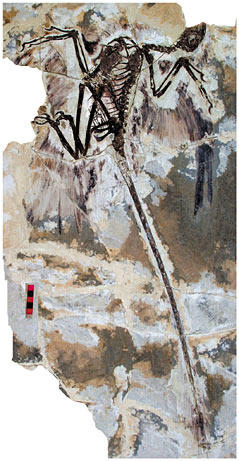
` Microraptor (as well as another find also called Cryptovolans) is what could be called a 'tiny, biplane terror', as this 15-inch long dinosaur had flight feathers on both its arms and legs.
` Being a relatively primitive dromaeosaur, it is less specialized than later ones and more birdlike: The rear teeth are constricted ('waisted'), and, unlike in its later relatives, are largely unserrated. The front teeth, as in birds, are not serrated at all. As for the tail, it is shorter than that of other dromaeosaurs, with larger fused vertebrae where the pelvis connects, and an ischium (pelvic-bone) more similar to that of the primitive bird Rahonavis.

` Even before the flight feathers were found, it was known to have patches of feather-like integument and thought to have climbed trees, which its curved, gripping claws and more backwards-pointing first toe seemed to be more suited for.
` The type specimen of this animal was actually the tail of 'Archaeoraptor', which was actually two fossils of similar size that a poor Chinese villager had glued together in the desparate hope of selling a 'complete' specimen of something on the black market - something he could have gotten killed for!
` Scientists didn't realize this at first, as they had never seen bones exactly like these before, and the press went to town before they could even scan the thing. It turned out, at least, to be a 'happy accident', as two new animals - Microraptor and Yanornis, a bird - were discovered from that incident.

` Today, the best of six more recent specimens show the wing-feathers. Xu et al wrote in Nature:
` "Large patches of integuments are preserved in situ around the skeleton, and the pattern of preservation is similar to that of early birds from the same locality. Integumentary structures are best preserved near the femur, where they run almost perpendicular to the bone. They are long (average 25-30mm) narrow, and have a feather-like contour, whereas those along the tibia and in the hip area are shorter. Some impressions of the integuments contain a structure similar to that of a rachis, suggesting that true feathers may have been present..."
` Today, it is thought that Microraptor could have glided with these 'four wings', which appear to employ asymmetrical feathers for flying. As the legs could not have sprawled out to the sides, it appears that the feet were positioned below the arms and the feathers sprouting from them formed a sort of 'slanted airfoil' below the wings.


(Unnamed in cladogram) I am assuming this refers to BPM 1 3-13 and/or possibly at that point NGMC 91.

` These animals were both dromaeosaurs, with teeth similar to those of Sinornithosaurus. Ji Qiang et al describe the animals in Nature:
` "In NGMC 91 integumentary filaments are distributed across the entire skull, body, limbs and tail, except for the distal hindlimbs. Unlike Sinosauropteryx, the structure and distribution of filaments are heterogenous. [Meaning more than one kind.] There are three basic types... single fibers, long 'sprays' of fibres that resemble the plumulaceous [downy] feathers of Protarchaeopteryx, and the fibers oriented around a central axis in a herringbone pattern that resembles the remiges [tail feathers] of Caudipteryx."
` "BPM 1 3-13 can be unequivocally referred to the Dromaeosauridae on the basis of derived characters, including elongate prezygapophyses and chevrons that span several vertebrae in the tail [which are what make it especially stiff], a retroverted [backwards-pointing] pubis, and a modified second pedal digit [the 'slashing' claw].... The feathers of BPM 1 3-13 are structurally identical to those of modern birds, indicating not only that modern feathers must have evolved in dinosaurs before the emergence of birds and flight, but also that the feather-like structures present in many other non-avian theropods are homologous [meaning the same thing, not just appearing to be] with feathers."
` An April 2001 press release from the American Museum of Natural History said of BPM,
'Its head and tail are covered with downy fibers. Other parts of its body sprout tufts or sprays of filaments resembling primitive feathers, and the backs of its arms are adorned with branched structures like the barbs of a modern bird feather...' 'The detail on the newly discovered dromaeosaur is so fine that it allows scientists to see how the primitive feathers were attached to the dinosaur's body.'
` At the AMNH's website, you can see lots of closeups of the feathers! Just click on the various images at the bottom of that page to view them.


Arcaheopteryx lithographica - (ark-ee-OP-ter-icks # lith-o-GRAF-i-ka)
[Greek] (f) 'ancient wing of the lithographic slate'
Place: Southern Germany
Time: Late Jurassic, 150 my ago.

` This primitive, crow-sized bird was found pressed between slabs of Jurassic-aged slate. The name Archaeopteryx actually comes from a feather first mentioned by Von Meyer in a letter in August, 1861. He did not apply this name, however, until September, at which time a 'feather-bearing animal' had been found in the same quarry. His German colleague J. A. Wagner described the animal also in 1861, proposing the name Griphosaurus ('enigma reptile'), although he had only seen a very detailed drawing and not the specimen itself.
` In 1863, Sir Richard Owen bought the feathered fossil skeleton and identified it as a toothed, long-tailed bird, adopting Von Meyer's name for the genus, Archaeopteryx. He proposed macrura (mak-ROO-ra - 'long tail') for a new species name, which, in time, was discarded. Today, this original Archaeopteryx is referred to as the 'London specimen', and there are six more to date!
` As for the creature itself, the 'true' feathers on Archaeopteryx's wings and tail were asymmetrical - just like those of modern flying birds - and with its large wishbone, it was obviously built for some level of powered flight. It would appear that the animal could fly rather like today's birds, although probably clumsily, as it did not have the alula ('bastard wing') of later-evolved birds.
` Interestingly, the Berlin specimen, the only one known to have body contour feathers, shows faint impressions of long wing-like feathers 2-3 cm long on the legs as well. They were quite faint before, but are quite visible with sensitive microscopic equipment. This suggests that Archaeopteryx may have evolved through a four-winged stage somewhat along the lines of Microraptor.
` Also suited for flight was Archaeopteryx's brain, which wasn't quite as big as that of modern birds, though it had a large visual cortex. The structure of its inner ears actually fits perfectly within the normal range of size and shape of modern birds, which tells us that it probably had a comparable sense of orienting itself.
` The feathered tail was rather more reduced than in most other maniraptors, having only 22 vertebrae, and its teeth were conspicuously unserrated like those of other birds. Archaeopteryx also had a hyperextendable second toe like the dromaeosaurs (to which it is most closely related). The first toe was turned backwards, and - though a bit too high on the foot to be optimal - was probably prehensile. Also, while other dinosaurs had movable skull-bones, Archaeopteryx also seems to have been able to move its top jaw up and down like modern birds do, though not as extensively.


Confuciusornis sanctus - (kon-FYOO-shus-OR-nis # SANG-tus)
[Greek, Latin](m) 'Confucius' sacred bird')
Place: Liaoning, China.
Time: Early Cretaceous, 120 my ago

` Many tens of specimens (I believe over a hundred so far) of this bird have been found in Liaoning, so it is an understatement to say that this genus is well-known. Apparently, they were a shore bird that frequently fell into the water, the females having a rather short, rounded fan of tail feathers, while two of the male's were very long and spoon-shaped, much like the ones some modern birds have. What really sets this bird apart from others is that it is the earliest bird known to have a toothless, horn-sheathed beak like modern birds!
` And yet... it is not thought to have evolved into modern birds! It was just similar.

` There are also many other species of primitive birds, such as Jeholornis prima - of the Jiufotang Formation in China, was a toothed bird with a dromaeosaur-like tail (w/27 vertebrae), a strong flying ability, and two fused fingers.
` Its feathers were not preserved, but 50 fossilized seeds were found where its stomach once was. It seems to fit somewhere in between the evolution of Archaeopteryx and Confuciusornis.

` For a partial cladogram of some of the other primitive birds and drawings of their skeletons (including enantiornithes - below), check this page out!


Enantiornithes ('opposite birds'), were a varied clade of primitive birds that apparently did not evolve into today's birds, but were rather a sister group that evolved from the same primitive flying ancestors as modern birds. The well-feathered Protopteryx fengnensis was one of them, which has many advanced characteristics of birds, though its hands and alular digits were long like those of Archaeopteryx and Confuciusornis.
` Though it lived in the Late Cretaceous period, in Madagascar, Rahona ostromi was an enantiornithine which had apparently retained many primitive characteristics, including unfused foot-bones, which had bore, as Forster et al wrote:
` "The most striking feature of the nearly complete left foot... is the structure of digit II. It is extremely robust relative to other digits... and distinctive in morphology... The digit ends in an enlarged sickle-shaped claw. [D]igit II was found in hyperextension, whereas digits III and IV were flexed. This distinctive morphology of an enlarged digit II is found only in dromaeosaurid and troodontid maniraptors..."
` In other words, it had retained an early characteristic, the slashing 'killer claw' until near the end of the 'Age of Dinosaurs'.
` As far as advanced characteristics go, Eoalulavis hoyasi ('dawn alula bird from Las Hoyas'), which lived 115 million years ago in Early Cretaceous Spain, is known to have had an especially advanced characteristic - the alula. Like the leading-edge wing-slats of a plane, the alula is needed to prevent stalling at slow speeds/high angles of attack, and so its presence shows that Eoalulavis would probably have been able to take off, land, and maneuver among tree branches as well as a modern bird can.


Euornithes ('true birds') - as I am too tired to describe one of these, so I'll just mention first names: Struthio, Haliaeetus, Erithacus, Ciconia, Aix, etc. If these seem to be unfamiliar species, put them into a search engine to jog your memory. ; )


` Anyhow, these are some of the first feathered nonavian dinosaurs described. When more species are uncovered, I will list their names in this post and write about them somewhere else. To learn a bit about feather development, go to Dinosaurs and their Descendents 4.